
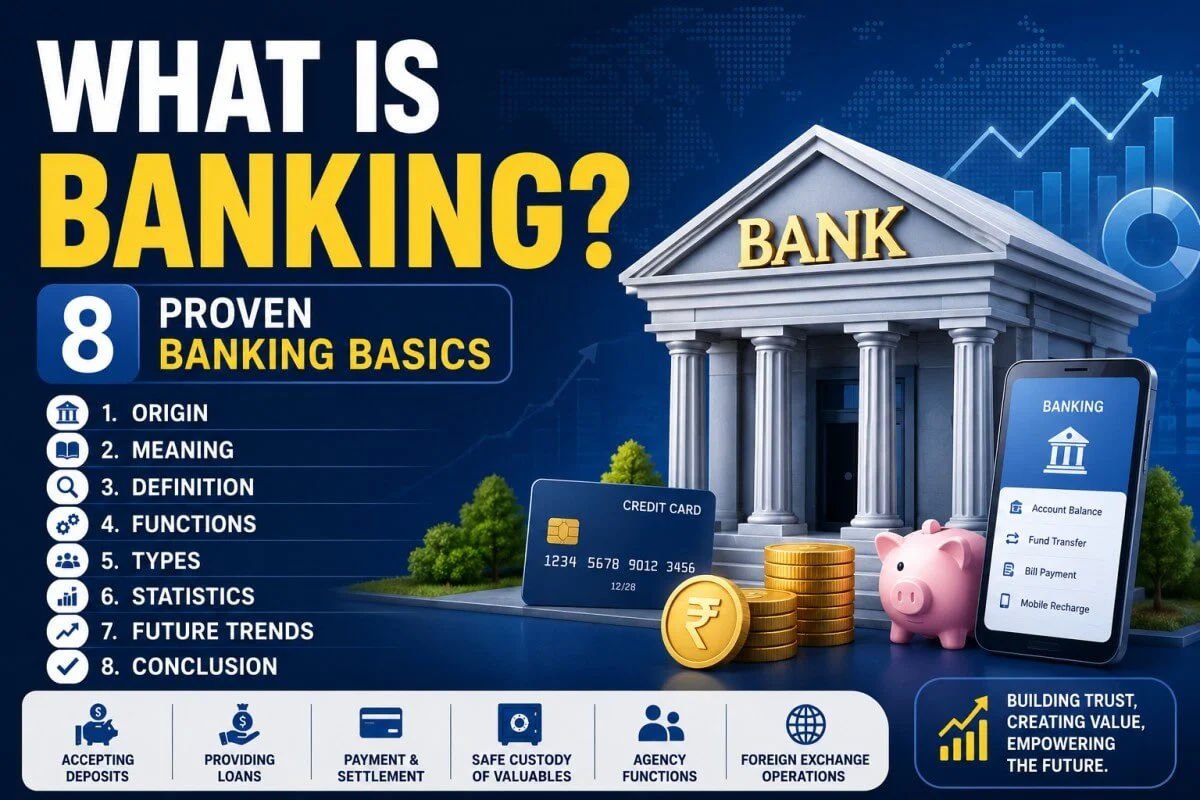
What is Banking? In this Banking Simplified guide, learn what banking is, its definition, types, functions, benefits and complete information about digital banking in simple Marathi. Useful guide for students and banking customers.
1. Introduction to Banking
While we are considering what is Banking?, remember that, in the modern era, economic transactions revolve around money. Consequently, money has acquired extraordinary significance within the economy. Banks play a pivotal role in economies; indeed, in both developed and developing nations, it is observed that individuals who save do not necessarily invest, nor do those who invest rely solely on their own savings.
Given the inherent complexity of the production process, the individuals who save and those who invest are often distinct entities. Banks perform the vital function of bridging the gap between these disparate groups, thereby ensuring continuity in the production process.
By acting as financial intermediaries, banks contribute significantly to the rapid growth of the economy. The role of banks is crucial across all sectors—including production, distribution, consumption, and exchange. Thus, banks serve as the very pillars of modern economies.
2. Origin of the Concept of Banking
It is widely believed that the term “Bank” originated from words such as *Banco* or *Bancus*. All these terms denote a “specific type of bench” or counter.
Historically, European Jewish moneylenders utilised such specific benches to conduct their financial transactions. As the practice of lending money gained considerable momentum, the term subsequently entered common parlance.
Historical records indicate that Jewish communities in the Lombardy region of England also utilised similar types of benches for their financial dealings. Furthermore, if a Jewish moneylender happened to go bankrupt—that is, suffer financial ruin—he would symbolically break his bench; it is surmised that the term “Bankrupt” subsequently evolved to describe any individual or institution that had suffered such financial collapse.
3. Meaning: What Is Banking?
Banking is the process through which banks and financial institutions manage money by accepting deposits, giving loans, enabling fund transfers, and providing a variety of financial services to people, businesses, and government organisations. In simple terms, banking helps maintain the smooth movement of money in the economy while supporting saving, investing, and daily financial transactions.
4. What is Banking Definition
1) Prof. Sayers’ Definition:
“Banks are institutions whose debts—referred to as deposits held by the public—are readily accepted in settlement of the debts of other institutions or individuals.”
2) Sir John Paget:
According to him, “Any individual or institution that does not accept deposits from the public, does not deal in savings or current accounts, does not issue or accept checks, and does not undertake the task of collecting the proceeds of any type of check on behalf of its account holders, cannot be termed a bank.”
This definition highlights the acceptance of deposits and the utilisation of checks as the key functions of a bank. He has emphasised the use of checks as a crucial characteristic. A bank’s operations are strictly confined to banking transactions; apart from banking activities, banks do not engage in any other types of business.
3) Gilbert’s Definition:
“A bank operator, or banker, functions as an intermediary between those who borrow money and those who lend it. The banker’s profit depends on the margin that remains between the transactions of borrowing and lending money.”
This definition places greater emphasis on the profit motive of a bank.
From all the definitions cited above, it becomes evident that, in addition to accepting deposits and granting loans, banks also perform various functions as agents.
5. Core Functions of a Bank
Commercial banks handle a significant portion of all banking transactions. Commercial banks are the oldest type of banks. Fundamentally, these banks operate by collecting deposits and conducting transactions based on them. In the modern era, the functions generally performed by banks can be broadly categorised into two types:
- A) Main Functions (or Primary Functions)
- B) Secondary Functions
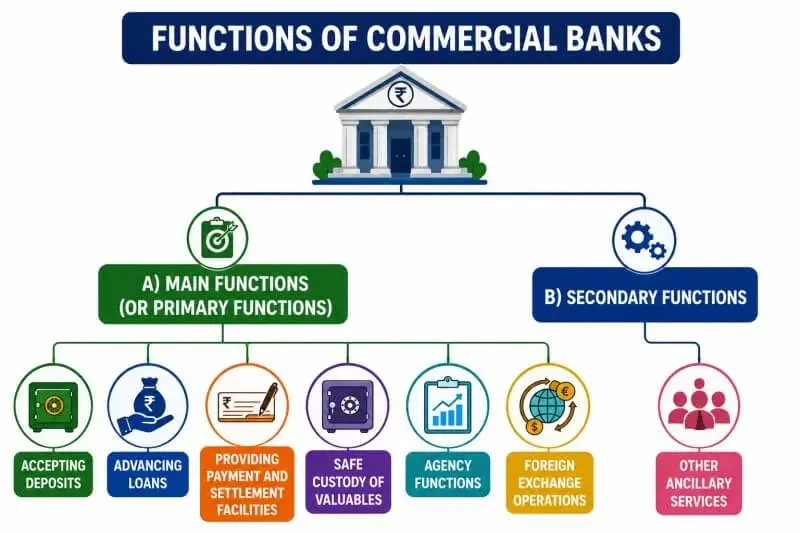
Modern commercial banks perform a wide variety of functions. Although there may be slight variations in banking operations depending on the specific country, time, and circumstances, their core functions remain essentially the same across the globe. The major functions of commercial banks are as follows:
A) Main Functions (or Primary Functions)
1. Accepting Deposits:
As an essential part of their business operations, banks accept deposits from their customers. They offer various types of deposit schemes designed to suit the diverse needs and conveniences of different categories of customers.
According to the World Bank’s Global Findex Report, nearly 79% of adults in the world have a bank account, indicating that the use of financial services is growing rapidly.
Banks generally accept four types of deposits, as outlined below:
A) Current Deposits:
Depositors holding a Current Account can withdraw their funds at any time—at their own discretion—without the need to provide prior notice to the bank. Large-scale merchants and business entities frequently engage in high-volume monetary transactions; consequently, most businesspeople opt to open a Current Account.
This type of account facilitates the smooth execution of large-scale, day-to-day financial transactions. It ensures the safety of funds while allowing for their utilisation whenever the need arises.
However, since the depositor retains the right to withdraw the funds from this account at any moment, banks are generally unable to utilise these specific funds for profitable long-term investment purposes.
B) Savings Deposits:
To cultivate the habit of saving and thriftiness among the common people of the middle class, this type of account imposes restrictions on depositors regarding when and how frequently they may withdraw funds. Furthermore, if the amount to be withdrawn from such a deposit is substantial, prior notice must be given to the bank.
C) Fixed Deposits:
In this type of deposit, a specific sum of money is held for a fixed tenure. Upon the expiration of this tenure, the total amount—including accrued interest—is returned to the customer as a lump sum. Generally, funds held in a fixed deposit cannot be withdrawn before the maturity period ends.
Banks can utilise these funds securely for profitable investment opportunities. Naturally, banks offer higher interest rates in proportion to the duration of the deposit tenure. When accepting such deposits, a Deposit Receipt is issued alongside the Fixed Deposit Agreement. Upon presenting the Deposit Receipt at the end of the tenure, the entire deposited amount, along with the interest, is refunded.
D) Recurring Deposits:
This Recurring Deposit Scheme is designed for small traders, salaried individuals, homemakers, and others, enabling them to make small, regular monthly savings over a period of several years and receive a lump sum payment at the end of the tenure. Since the customer sees their money double over a period of five years and receives a substantial lump sum at the end, the funds accumulated through a Recurring Deposit can be utilised securely and effectively.
2) Lending(Loans and Advances):
Banks primarily extend short-term loans to their customers. This is because the capital they lend is largely derived from deposits accepted under the condition that they must be repaid to the depositors on demand. Banks offer various types of loans tailored to meet the specific needs of their customers. Among these, the following types of credit facilities are particularly significant:
a) Cash Credit:
In India, all commercial banks offer Cash Credit facilities. An individual seeking a loan approaches the bank, offering the necessary collateral (security). The bank verifies the validity and adequacy of the collateral provided. Once the bank is satisfied that the collateral is sufficient and reliable, it approves the loan for the borrower.
A bank account is opened in the borrower’s name. The sanctioned amount is deposited into that individual’s account. The borrower is issued a chequebook. The borrower is free to withdraw any amount they require from their account. Interest is charged only on the specific amount that the borrower has actually utilised.
b) Overdraft Facility:
Under the overdraft facility, an account holder is permitted to withdraw an amount exceeding their existing account balance, based on their specific requirements. The bank determines the maximum limit—that is, the maximum amount that can be withdrawn in excess of the deposited funds.
The bank charges interest solely on the actual amount utilised by the account holder. This type of overdraft facility is typically sanctioned for a maximum duration of 90 days or less.
c) Term Loans:
Commercial banks also sanction lump-sum loans. These loans are predominantly short-term in nature. In addition to short-term loans, banks also provide medium-term loans (typically for 1 to 3 years) and long-term loans (typically for 3 to 5 years).
Commercial banks generally prefer to avoid granting long-term loans, as they prefer to maintain their funds in a liquid (cash) form. Long-term loans result in funds remaining locked up for an extended period. Furthermore, if the specific production activity for which these funds were utilised proves to be unsuccessful, there is a risk that the money may be lost (become irrecoverable).
3) Discounting of Bills:
The discounting of bills is a highly significant function performed by commercial banks.
Example: Suppose ‘A’, a merchant, travels from Pune to Mumbai to make purchases and buys certain goods from ‘B’ Company. The merchant instructs ‘B’ to ship the purchased goods—along with the corresponding invoice—to his address in Pune.
On this invoice, merchant ‘A’ signs to acknowledge and accept the responsibility for paying the specified amount. Merchant ‘B’ then forwards the relevant goods and the invoice to a bank branch in Pune, addressed to ‘A’.
The bank notifies ‘A’ regarding the arrival of the goods and the total value of the consignment. Merchant ‘A’ subsequently deposits the requisite amount into merchant ‘B’s account.
Typically, the merchant is required to settle the bill amount within a specific timeframe (usually within a day). In essence, during the period spanning from the discounting of the bill until the realisation of the funds, the bank effectively extends a form of credit to the bill-holder.
B) Secondary Functions of Banks:
1) Acting as an Agent for Account Holders:
Some banks perform specific functions by acting as agents or representatives on behalf of their account holders. This involves collecting receivables and settling liabilities for the account holder.
‘Receivables’ include income received in forms such as rent, interest on capital, dividends on share capital, and business profits. ‘Liabilities’ involve making payments such as house rent, insurance premiums, property taxes, water charges, etc. In addition to these tasks, banks—through their team of experts—undertake activities such as purchasing or selling shares, bonds, debentures, savings certificates, mutual funds, secured bonds, etc., whenever the account holder requires them to do so. Banks earn a commission for performing these services.
2) Acting as a Trustee:
An individual may entrust a bank with the responsibility of managing their assets and property after their demise, designating the bank to act in the capacity of a trustee. Banks safeguard the assets of a deceased individual until their children attain legal majority. Once the children come of age, the banks transfer the assets to them. Banks earn a service fee or commission for performing this task.
3) Money Transfer:
Just as money can be sent from one location to another via Money Orders through the Post Office, banks perform a similar function. They facilitate the transfer of funds from one place to another—charging a nominal commission—using instruments such as cheques, Demand Drafts, Mail Transfers, Telegraphic Transfers, etc.
This banking function makes it possible to transfer money from one location to another with great speed, thereby contributing to increased dynamism in financial transactions.
4) Providing Financial References (Letters of Credit):
This service is also referred to as a ‘Letter of Credit.’ If a merchant wishes to conduct large-scale financial transactions abroad, a bank can issue a Letter of Credit on their behalf, thereby enhancing their creditworthiness in the international market. Should the merchant who received this guarantee prove unable to settle their foreign liabilities, the bank—having vouched for them—steps in to settle the dues. Banks earn a commission for issuing such Letters of Credit.
5) Issuing Traveller’s Cheques:
Travelling both within one’s own country and abroad often entails significant financial expenditure. Carrying large amounts of cash while travelling can be risky. Recognising this difficulty faced by travellers, banks issue ‘Traveller’s Cheques’ to those embarking on journeys.
A traveller deposits a specific sum of money with the bank and, in exchange, receives a booklet of Traveler’s Cheques. Whenever the need arises during their travels, the individual can encash a cheque for the required amount at any bank designated by their issuing bank. The cheques are duly encashed after the bank verifies the signatures and identification documents of the traveller.
6) Provision of Safe Deposit Lockers (Safe Custody, Safe Vaults):
Keeping important documents, shares, debentures, bonds, savings certificates, and valuable jewellery at home can be risky. Banks assume the responsibility of safeguarding all such items securely by providing safe deposit locker facilities.
Banks make these safe deposit lockers available to their account holders for a period of one year in exchange for a nominal annual rent. Each safe deposit locker is equipped with two keys: one key is held by a bank official, while the other is held by the customer.
The locker opens only when both keys are inserted simultaneously. It is the customer utilising the locker who decides what to store inside it and what to exclude. In recent times, banks have begun requesting an inventory of the items kept within the safe deposit lockers. This list is requested to ensure that compensation can be provided in the event that the locker is burgled or robbed.
7) Assisting in Capital Formation:
In the modern era, the establishment of industries, as well as their modernisation and expansion, requires substantial capital. To raise this capital, industrial organisations often sell shares or debentures in the open market; banks undertake the responsibility of facilitating these sales and thereby securing the necessary capital.
If the shares or debentures are not sold within the stipulated timeframe, the banks themselves purchase the remaining securities, thereby ensuring that the required capital is raised. Banks charge a commission for rendering this service.
Thus, by performing a diverse range of functions in the modern era, banks contribute both directly and indirectly to the task of nation-building.
6. Types / Classification of Banks
A) Structural Classification of Banks
Here, we will examine how banks are categorised from a structural perspective. The structure of the banking sector in any country depends upon that nation’s economic, social, and, at times, political conditions. The nature of the economy’s requirements plays a pivotal role in determining the structural framework of the banking industry.
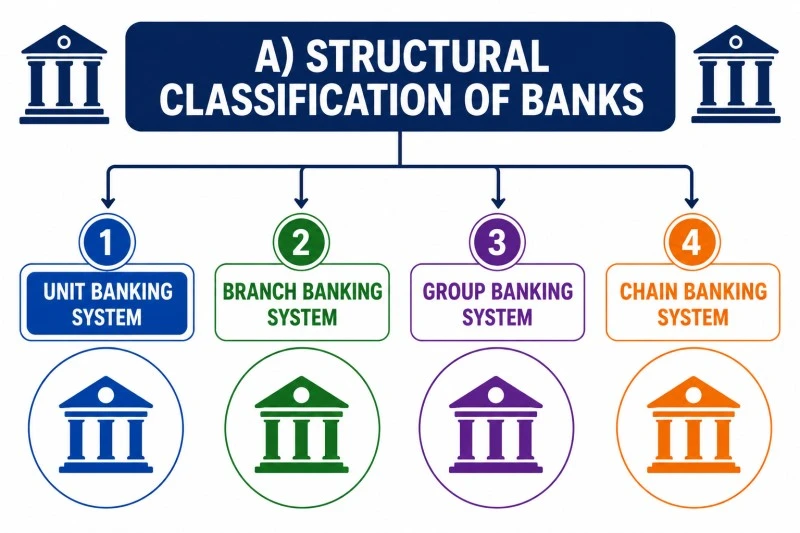
Based on this structural consideration, banks are broadly classified into the following types:
- 1. Unit Banking System
- 2. Branch Banking System
- 3. Group Banking System
- 4. Chain Banking System
Let’s discuss in simple word.
1. Unit Banking System
The Unit Banking System can be regarded as the original or foundational method of banking operations. The scope of a unit bank’s operations is limited. Such a bank does not maintain any branches elsewhere. It performs various functions for its customers exclusively through its single, solitary office.
Although the Branch Banking System is prevalent in most countries across the world today, the Unit Banking System has notably retained its popularity within the United States. The Unit Banking System currently exists in many constituent states of the U.S. Furthermore, it has been observed that, in recent times, several U.S. states have actively encouraged and promoted this system.
2) Branch Banking System
In the branch banking system, a bank maintains a central office, while its branches operate across various regions of the country. Typically, the central office is established in a major city within the country.
Since branch expansion constitutes the bank’s core strategy, there is no limit to the number of branches a bank may establish under this system. Naturally, however—as the country’s Central Bank serves as the regulator of banking operations—the bank is required to obtain the Central Bank’s prior permission for any branch expansion. Furthermore, under this system, a bank’s branches may also be opened in foreign countries.
3. Group Banking
A banking system in which two or more banks are directly or indirectly controlled by a single joint-stock company or a trust is known as Group Banking. Under this system, two or more banks operate their banking businesses independently; they do not have a direct operational relationship with one another.
However, they remain under the direct or indirect control of a single holding company. Because these banks function under unified control and engage in mutual cooperation, they are able to expand rapidly. Furthermore, as cooperation among the banks increases, they are not required to maintain excessively large cash reserves.
4. Chain Banking System
In this system as well, a single individual or a group of individuals establishes control over multiple banks. To establish such control, shares of various banks are purchased in large quantities, or an attempt is made to appoint specific individuals to the Boards of Directors of these various banks. Banks are brought under control either by purchasing their shares or by taking over their Boards of Directors.
In reality, the objective of both the Group Banking System and the Chain Banking System is essentially the same: to bring multiple banks under common control. However, the methods employed to achieve this differ.
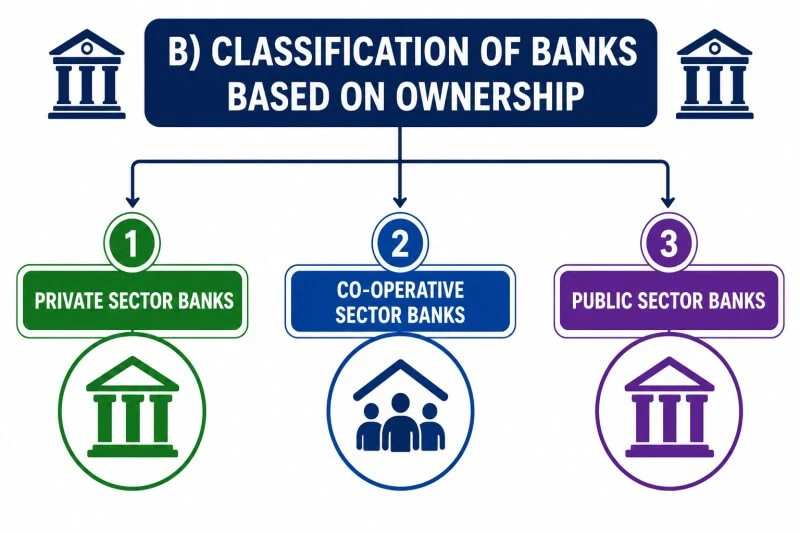
B) Classification of Banks Based on Ownership
- 1) Private Sector Banks
- 2) Co-operative Sector Banks
- 3) Public Sector Banks
Let’s discuss in simple words
1) Private Sector Banks
Banks operating in the private sector are primarily in the form of joint-stock companies. In addition to these, traditional banks operating on the principles of sole proprietorship or partnership also exist. These banks are typically owned by a single individual or a single family. Such banks may be referred to as traditional-style banks.
2) Banks in the Co-operative Sector
Certain individuals voluntarily come together to establish a business based on the principle of collective responsibility.
According to experts, a co-operative organisation is one in which both the ownership and the management rest with the consumers who utilise the services provided by that organisation. The affairs of such an organisation are conducted in a democratic manner.
The organisation provides services not only to its own members but also to the general public. Banks that operate on these co-operative principles are known as co-operative banks.
3) Public Sector Banks
The principle that a country’s central bank should not be under the control of private capitalists has gained acceptance since the beginning of the current century.
This is because such a bank performs functions of public interest—such as currency issuance—and serves as the banker to the government as well as the banker to other banks. Today, in almost every country across the globe, central banks are state-owned.
In India, the Reserve Bank was nationalised on January 1, 1949. The entire capital of this bank is owned by the state, and its operations are controlled by a Board of Directors appointed by the Government of India.
There are significant differences in both the structure and objectives of banks operating in the public sector compared to those in the private sector.
Furthermore, there is a substantial disparity in the operational methods and management styles of banks in these two sectors. Consequently, it becomes essential to undertake a comparative study of the objectives and operational procedures of both types of banks.
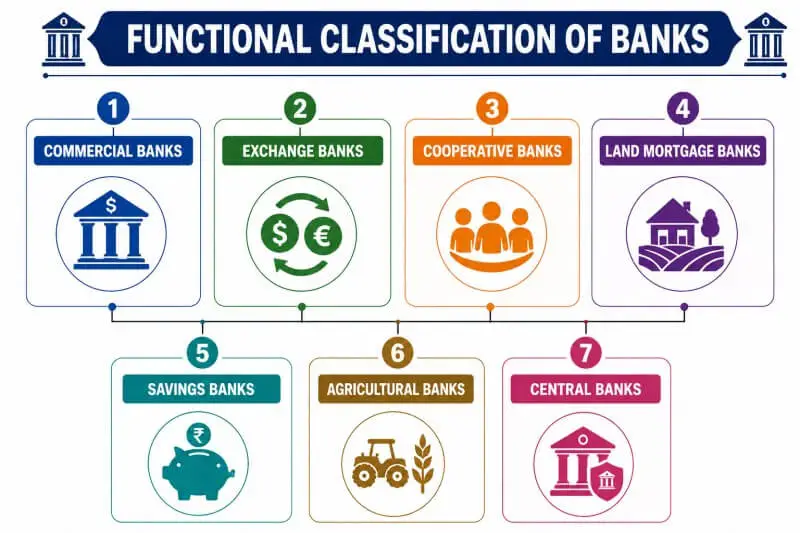
C) Functional Classification of Banks
When banks are classified based on their specific functions, this classification is referred to as the Functional Classification of Banks. Accordingly, the classification of banks is as follows:
1) Commercial Banks:
(Nationalised in 1969). Commercial banks were established with objectives such as fostering trade within the economy, enabling the trading community to conduct their financial transactions with ease, and helping them overcome financial difficulties.
A primary function of these banks is to provide credit to traders; hence, they are known as Commercial Banks. These banks accept short-term deposits from citizens within the economy and utilise the accumulated deposits to grant short-term loans to traders. Furthermore, these banks perform the function of discounting bills of exchange (hundis) drawn by traders.
2) Exchange Banks:
To ensure the smooth flow of international trade, the exchange of the respective countries’ currencies is of paramount importance. Exchange banks are established specifically to facilitate this function.
These banks perform crucial tasks that support international trade, such as buying and selling foreign currency and providing facilities for discounting foreign bills of exchange.
3) Cooperative Banks:
Cooperative banks are established based on the principle of mutual cooperation. The primary objective of cooperative banks is to provide assistance to individuals who hold membership in the bank.
Cooperative banks have been established across various sectors, ranging from rural villages to large metropolitan cities.
Examples include Industrial Cooperative Banks, Agricultural Cooperative Banks, Housing Cooperative Societies, etc. These banks primarily provide short-to-medium-term credit to meet the financial requirements of smaller sectors within the country.
4) Land Mortgage Banks:
Land Mortgage Banks were established to provide long-term credit to the agricultural sector. When granting loans for agricultural purposes, these banks accept farmland as collateral (mortgage) and disburse the loan amount to the farmers. Such loans are generally granted for purposes such as agricultural mechanisation, facilitating the enhancement of production capacity, and so forth.
5) Savings Banks:
Generally, banks accept deposits from the public and provide loans to those in need of funds. However, some banks accept deposits but do not extend loans; such institutions are known as Savings Banks. The primary function of these banks is to cultivate saving habits among the public and to aggregate the small-scale savings held by a large number of individuals.
In a practical sense, Savings Banks are not ‘banks’ in the traditional commercial sense; rather, they are institutions dedicated solely to mobilising the savings of the general public. These banks serve the purpose of encouraging low-income earners and individuals within specific fixed-income brackets to save, thereby providing them with opportunities to make investments.
In most countries across the world, post offices maintain a dedicated department for managing savings accounts. With the modern availability of postal services, this department operates efficiently and enjoys the public’s trust, resulting in a strong and positive response from the people.
Most importantly, since these funds are deposited with the government, the government can utilise this capital for public welfare initiatives. In this model, the depositors and the shareholders of the bank are the same; consequently, the depositors themselves act as the owners of the institution.
6) Agricultural Banks
Agriculture constitutes a vital sector within every economy. Much like industry and commerce, this sector also requires access to credit. Such credit is typically required for short-to-medium-term durations. However, in their early stages of development, commercial banks were generally reluctant to extend loans for agricultural purposes.
The reasons for this reluctance included the inherent uncertainty associated with agricultural yields, fluctuations in land values, the lack of adequate collateral, and concerns regarding farmers’ capacity to repay loans. Due to this confluence of factors, commercial banks refrained from lending to the agricultural sector.
Consequently, Agricultural Banks were established specifically to ensure a steady supply of credit to the farming community. Through these institutions, loans are disbursed to farmers against the collateral of their land holdings. To ensure adequate credit availability across various regions, a network of branch offices has been established by these banks.
7) Central Banks:
Although banks play a pivotal role in the economy of every nation, their operations are driven by a profit motive; consequently, in their pursuit of maximising earnings, there is a possibility that banks may engage in activities detrimental to the economy.
This can lead to inflation, the adverse effects of which must ultimately be borne by society as a whole. In the modern era, Central Banks have emerged as integral institutions within almost all economies. The primary functions of a Central Bank include acting as the government’s banker; issuing and controlling currency; regulating all banking operations within the country and providing guidance when necessary; exercising credit control; and serving as the nation’s apex banking institution.
Central Banks do not engage in direct transactions with the general public; they neither accept deposits from individuals nor provide loans to them. Instead, they indirectly extend assistance to sectors such as agriculture, industries, and cooperative societies.
The Central Bank also undertakes tasks such as providing financial support—when deemed necessary—to various institutions involved in power generation and supply. Typically, every country possesses a single Central Bank, the ownership and management of which rest with the government. The Central Bank occupies a position of paramount importance within the money market.
8) International Banks
During the Second World War, numerous restrictions were imposed on international transportation and trade. Consequently, significant difficulties arose in conducting international transactions and exchanges, leading to the emergence of various problems.
To resolve these difficulties and facilitate the smooth flow of international trade, it became necessary to undertake efforts at a global level. In 1944, a meeting of the world’s peace-loving nations was held at Bretton Woods.
During this meeting, two institutions were established—the World Bank (or the International Bank for Reconstruction and Development—IBRD) and the International Monetary Fund (IMF)—with the objectives of stabilising exchange rates and alleviating tensions between nations.
Simultaneously, the Asian Development Bank and the International Finance Corporation were also established. Many countries are members of these banks. These institutions provide financial assistance at the international level. Loans are granted to member nations by these institutions. Furthermore, loans are made available to member nations by these institutions to support their internal development.
7. Banking Statistics You Should Know
The growth of digital banking and financial services has transformed India rapidly. The table below highlights important banking statistics.
| Banking Statistics in India | Data |
|---|---|
| Total Bank Accounts under PMJDY | 55+ Crore |
| UPI Transactions Monthly | 18+ Billion Transactions |
| Internet Banking Users in India | 150+ Million |
| ATM Machines in India | 2.5+ Lakh |
| Digital Payment Growth | 40%+ Annual Growth |
| RBI Established | 1935 |
| Public Sector Banks in India | 12 |
| India’s Financial Inclusion Rank Growth | Rapidly Improving |
Source: RBI Reports, NPCI Data, Ministry of Finance Reports (2025)
8. The Future Trends of Banking
In the future, banking will become more digital and AI-based.
The following are the Future Trends of Banking
- Voice Banking
- Blockchain Banking
- Biometric Authentication
- AI Financial Assistant
Many reports show that the digital banking market is growing rapidly.
Conclusion
In today’s digital age, it has become very important to understand “What is Banking?”. Banking is no longer limited to depositing money. Banking has become essential for savings, loans, investments, digital payments and financial security.
Banking services have become an important part of life for everyone — students, employees, professionals or ordinary citizens. With proper banking knowledge, people can make safe and smart financial decisions.
At MoneyPedia Blog, spreading awareness about what is banking can help students and banking customers understand modern financial systems more effectively.
FAQ
1. What is Banking?
Banking is the system of accepting deposits from people, lending, transferring money and providing various financial services. Banks help individuals, businesses and governments to facilitate financial transactions.
2. What is the meaning of banking terms?
Banking terms are financial terms used in the banking sector. For example:
Deposit
Loan
Interest
Savings Account
Credit Card
These terms are important to understand banking transactions.
3. Why is it called banking?
The word “Banking” comes from the Italian word “Banco”. “Banco” means bench or table. Earlier, money changers used to do transactions sitting at a table. From that, the word “Bank” and later “Banking” became popular.
4. Who is called the father of banking?
Alexander Hamilton is generally considered the father of modern banking. He played a key role in the development of the American financial and banking system.
The Reserve Bank of India (RBI) and the Hilton Young Commission are also considered important in the development of modern banking in India.
Disclaimer
This article is prepared for educational and informational purposes only. Banking rules, interest rates and monetary policies may change from time to time. Please verify information with an authorised bank or related organisation before making any financial decision.
References
- Bharati V. Pathak, Indian Financial System, Pearson Education, 2022.
- K.C. Shekhar & Lekshmy Shekhar, Banking Theory and Practice, Vikas Publishing House, 2021.
- R.S. Sayers, Modern Banking, Oxford University Press, 2018.
- S.N. Maheshwari & S.K. Maheshwari, Banking Law and Practice, Kalyani Publishers, 2020.
- Gordon E. & Natarajan K., Banking Theory, Law and Practice, Himalaya Publishing House, 2021.
- Sundharam K.P.M. & Varshney P.N., Banking Theory, Law and Practice, Sultan Chand & Sons, 2019.
- Dr. Panandikar S.G. & Mithani D.M., Banking in India, Orient Longman, 2017.
- M.Y. Khan, Indian Financial System, McGraw Hill Education, 2020.
- Reserve Bank of India (RBI) Annual Report, 2025
- Banking Regulation Act, 1949

Hello! I’m Abhijeet Bendale, founder of MoneyPedia (Your Trusted Banking Guide). With 8 years of experience in the education field, I aim to simplify banking and personal finance topics for everyday readers through easy-to-understand guides and tutorials.
At MoneyPedia, I share informative content on UPI, digital payments, net banking, ATM and debit cards, mobile banking, and other essential banking topics to help users make smarter financial decisions with confidence.
1 thought on “What is Banking? 8 Proven Banking Basics (Meaning,Functions & Types,Future Trends)”