
The banking sector is a vital component of the country’s economic system. Consequently, appropriate regulations and controls are essential for establishing and conducting banking operations in India. Under the provisions for the licensing of banking companies, obtaining a license from the Reserve Bank of India (RBI) is mandatory before commencing banking operations.
The RBI grants this license after considering various factors, such as the bank’s financial strength, the interests of depositors, management quality, capital structure, public interest, and the need for banking facilities. Furthermore, the law provides for the cancellation of the license if necessary conditions are not met, as well as the right to appeal against such a decision. In this article, let us examine in detail six key provisions regarding the licensing of banking companies.
Licensing of Banking Companies
The provisions included under Section 22 of the Banking Regulation Act regarding the granting of permission to start banks are as follows:
(1) Requirement of a License:
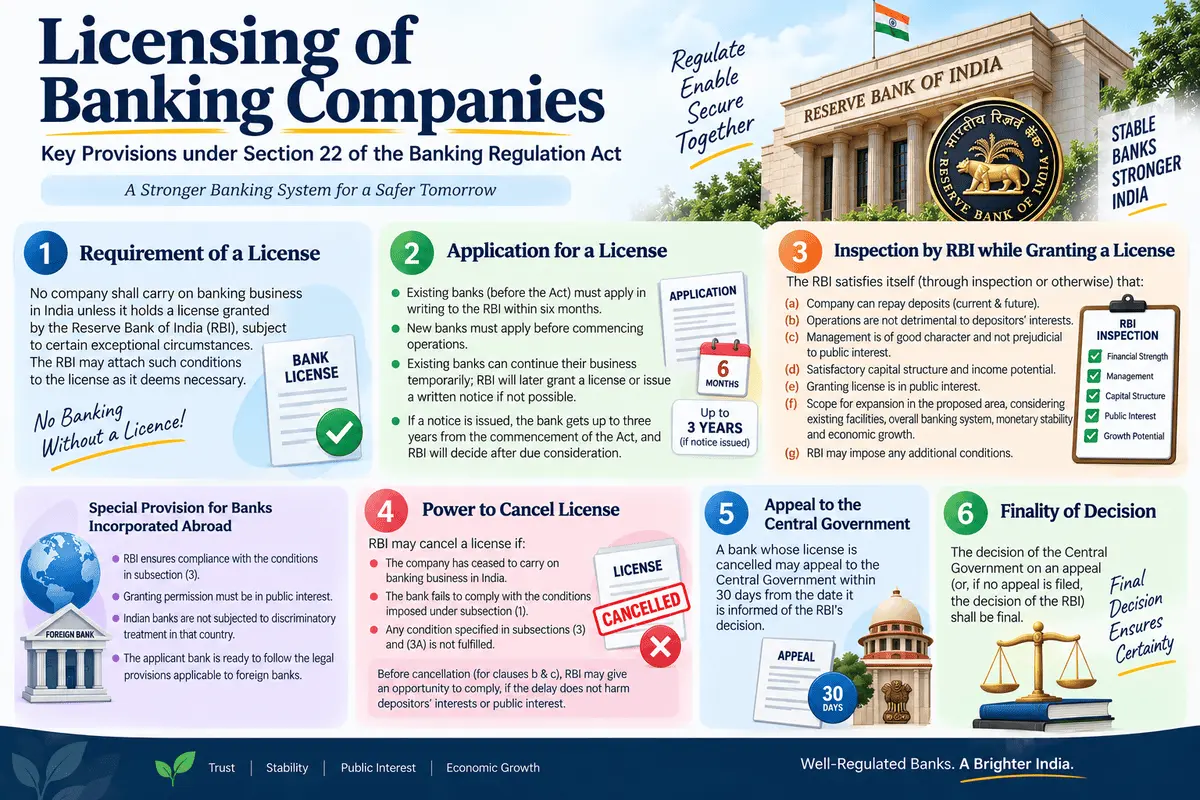
Subject to certain exceptional circumstances specified later, no company shall carry on banking business in India unless it holds a license granted by the Reserve Bank, and the Reserve Bank shall attach such conditions to the license as it deems necessary.
(2) Application for a License:
Banks existing prior to the commencement of this Act must apply in writing to the Reserve Bank within six months, and banks coming into existence subsequently must apply before commencing operations to obtain a license to carry on banking business in India.
However, the provision under subsection (1) regarding the requirement of a license shall not apply to banks existing at the time of the Act’s commencement for the purpose of continuing their banking business; the Reserve Bank shall subsequently either grant a license or, if granting a license is not possible, issue a written notice to that effect to the bank.
Furthermore, should such a notice be issued, the existing bank shall be granted a period of up to three years from the commencement of the Act, and the Reserve Bank shall take an appropriate decision in this regard after due consideration.
(3) Inspection by the Reserve Bank while granting a license:
Before granting a license under this section, the Reserve Bank shall satisfy itself—through an inspection of the company’s books or by other means—that the following conditions are being met:
- (a) The company seeking the license must be in a position to repay the deposits of current and future depositors upon maturity or when demanded by the depositors;
- (b) The present or future operations of the company must not be detrimental to the interests of current or future depositors;
- (c) The general character of the company’s proposed management must not be prejudicial to the public interest or the interests of depositors;
- (d) The company possesses a satisfactory capital structure and a satisfactory potential for generating income;
- (e) Granting permission to commence banking business in India must be conducive to the public interest;
- (f) Consideration will be given to whether there is scope for further expansion in the region where banking facilities are proposed—assessed against existing facilities—and whether there is room for a new bank, taking into account the overall banking system, monetary stability, and economic growth;
- (g) The Reserve Bank may impose any additional conditions it deems necessary for commencing banking business in India.
Special provision for banks incorporated abroad:
Before granting a license under Section 3(a) to any banking company incorporated outside India, the Reserve Bank shall satisfy itself—by inspecting the company’s books or otherwise—that the company complies with the conditions laid down in subsection (3), that granting permission to operate in India serves the public interest, that Indian banks are not subjected to discriminatory treatment in the country where the applicant company is incorporated, and that the applicant bank is prepared to strictly adhere to the legal provisions applicable to banks incorporated outside the country.
(4) Power to cancel license:
The Reserve Bank may cancel a license granted to a banking company under this section:
- (a) if the company has ceased to carry on banking business in India;
- (b) if, at any time, the bank fails to comply with the conditions imposed under subsection (1) (or contravenes such conditions); or
- (c) if, at any time, any condition specified in sub-sections (3) and (3A) is not fulfilled.
However, before cancelling the license under the provisions of clauses (b) and (c) mentioned above, the Reserve Bank may grant the concerned bank an opportunity to fulfill the requirements—subject, of course, to certain conditions—and provided that such delay has not prejudiced the interests of the company’s depositors or the public interest.
(5) Appeal to the Central Government:
A bank against which action has been taken—resulting in the cancellation of its license under this section—may appeal to the Central Government within thirty days from the date on which it is informed of the Reserve Bank’s decision.
(6) Finality of Decision:
The decision of the Central Government regarding an appeal filed under sub-section (5) above—or, if no appeal is filed, the decision of the Reserve Bank (under sub-section 4)—shall be final.
Conclusion: Licensing of Banking Companies
The provisions regarding the licensing of banking companies demonstrate the Reserve Bank’s effective control over the banking business in India. A license from the Reserve Bank is mandatory to commence banking operations in the country; the granting of such a license involves the consideration of crucial factors such as the interests of depositors, the company’s financial strength, capital structure, management, public interest, the need for banking facilities, monetary stability, and economic growth.
Necessary conditions and non-discriminatory treatment are also ensured for banks registered abroad. The Reserve Bank holds the authority to revoke the license if a bank fails to comply with the licensing conditions. Furthermore, the concerned bank is provided an opportunity to appeal to the Central Government within 30 days. Thus, the primary objective of these provisions is to safeguard the interests of depositors and the public while ensuring a safe and orderly banking system.
Frequently Asked Questions (FAQs) on Licensing of Banking Companies
1. What are the licensing requirements for banks in India?
Banks in India need a license from the Reserve Bank of India (RBI) before starting banking business. The RBI checks the bank’s financial position, capital structure, management, depositors’ interests, and public interest before granting the license.
2. Who gives a license to a bank in India?
The Reserve Bank of India (RBI) gives licenses to banks for carrying out banking business in India. The RBI may also impose certain conditions while granting the license.
3. What are the RBI guidelines for licensing new banks?
While granting a license, the RBI considers factors such as the bank’s ability to repay deposits, financial strength, management, capital structure, public interest, banking facilities in the proposed area, monetary stability, and economic growth.
4. Which bank license was cancelled by RBI recently?
RBI has cancelled licenses of certain banks from time to time when they fail to meet regulatory requirements or are unable to protect the interests of depositors. For a specific recent cancellation, the bank and date should be checked from the latest RBI notification.
5. Which banks share a banking license?
Banks generally operate under their own banking licenses. However, some banking groups may operate different banking entities under the same group, while each entity remains subject to the applicable RBI licensing and regulatory requirements.

Hello! I’m Abhijeet Bendale, founder of MoneyPedia (Your Trusted Banking Guide). With 8 years of experience in the education field, I aim to simplify banking and personal finance topics for everyday readers through easy-to-understand guides and tutorials.
At MoneyPedia, I share informative content on UPI, digital payments, net banking, ATM and debit cards, mobile banking, and other essential banking topics to help users make smarter financial decisions with confidence.