
What is Meant by NPA in Banking? Imagine This…Ramesh took a loan of ₹5 lakh from a bank to start his own small business. For the first few months, he paid the EMI on time. However, due to sudden losses in the business, he was unable to pay the instalments for three consecutive months. In the fourth month, he received a notification from the bank that his loan had been classified as NPA (Non-Performing Asset).
Ramesh wondered—”What exactly is NPA? How will it affect me and the bank?”This question comes to the minds of many bank customers, students and candidates preparing for competitive exams.
In this article, we will understand in simple terms what NPA is in Banking, how it is formed and what every borrower needs to know about it.
If you want to understand the basic concept of banking, be sure to read our detailed article, “What is Banking?”
Quick Takeaways
- An NPA (Non-Performing Asset) is a loan for which the EMI, interest, or principal amount has remained unpaid for 90 days or more.
- Under the RBI’s ’90-Day Rule,’ such a loan is classified as an NPA.
- There are three categories of NPAs: Sub-Standard Asset, Doubtful Asset, and Loss Asset.
- Key reasons for a loan becoming an NPA include financial distress, business losses, excessive debt, high EMIs, and medical emergencies.
- NPAs reduce a bank’s profitability, diminish its capacity to issue new loans, and can impact the economy.
- Paying EMIs on time, borrowing within one’s income limits, and maintaining an emergency fund are effective ways to avoid NPAs.
- Not every NPA is necessarily a ‘bad loan,’ but every bad loan begins as an NPA.
- Banking customers, B.Com/MBA students, and banking exam aspirants must understand the concept of NPAs.
1. What is Meant by NPA in Banking?
Suppose you have taken a loan from a bank and, due to some reason, you have not been able to pay the EMI or interest amount for 90 days or more in a row.
In such a situation, as per the rules of the Reserve Bank of India (RBI), that loan is known asan NPA (Non-Performing Asset). But what exactly isan NPA? In simple terms, a loan from which the bank stops getting the expected interest or income is called a Non-Performing Asset (NPA).
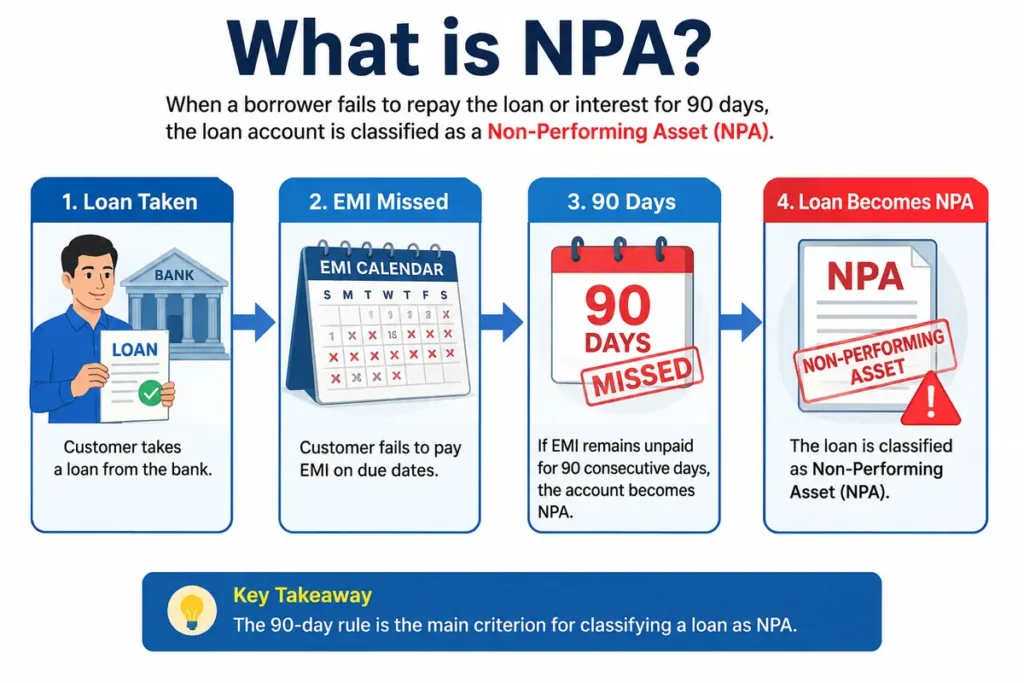
Because for a bank, a loan is an asset and the interest earned on it is its important source of income. Therefore, when the borrower does not repay on time, that loan ceases to be an income-generating asset for the bank and is classified as an NPA.
2. Why is a Loan Called an Asset for a Bank?
When we usually think of an asset, we think of a house, land, gold or other valuables. But from the bank’s perspective, a loan is also an important asset. Because when a bank gives a loan to a customer, the interest earned on that loan is its main source of income.
Therefore, if a customer pays EMI on time every month, that loan is considered an income-generating asset for the bank. But if the borrower does not repay the EMI or interest for a long time, the bank stops getting income from that loan. In such a case, that loan is classified as a Non-Performing Asset (NPA).
3. RBI’s 90-Day Rule Explained
Have you ever wondered when exactly a bank declares a loan as NPA? Just missing one or two EMIs does not make a loan NPA.
The Reserve Bank of India (RBI) has set a 90-day rule for this. That is, if you do not pay the EMI, interest or principal instalment of a loan for 90 consecutive days, the bank can classify that loan as a Non-Performing Asset (NPA).
This rule is important not only for the bank, but also for the customer. Because it helps the bank to know promptly which loans are being repaid regularly and which are overdue. Due to this, the bank can take appropriate action and transparency and financial discipline are also maintained in the banking system.
Therefore, if you have taken a loan, paying EMI on time is the easiest and most effective habit to avoid NPA.
The RBI has issued detailed guidelines under the RBI Prudential Norms (IRACP) for classifying loans as NPAs.
4. How Does NPA Affect Banks?
Now you must have a question in your mind: what exactly is the loss to the bank if a loan becomes NPA? After all, the loan is taken by one person, so why does it have such a big impact on the bank?
The answer is very simple. The main income of the bank comes from interest on the loan. Therefore, when a borrower does not receive EMI or interest for a long time, the bank’s income from that loan also stops.
As a result, the bank’s profit is directly affected. Not only this, the bank has to set aside some amount considering the possibility of losses due to such loans in the future. This is called Provisioning. Due to this, the funds available to the bank to lend to new customers may decrease . That is why every bank tries to keep the NPA ratio as low as possible.
Because the lower the NPA, the stronger the financial position of the bank and the better its lending capacity remains.
5. Types of NPA in Banking
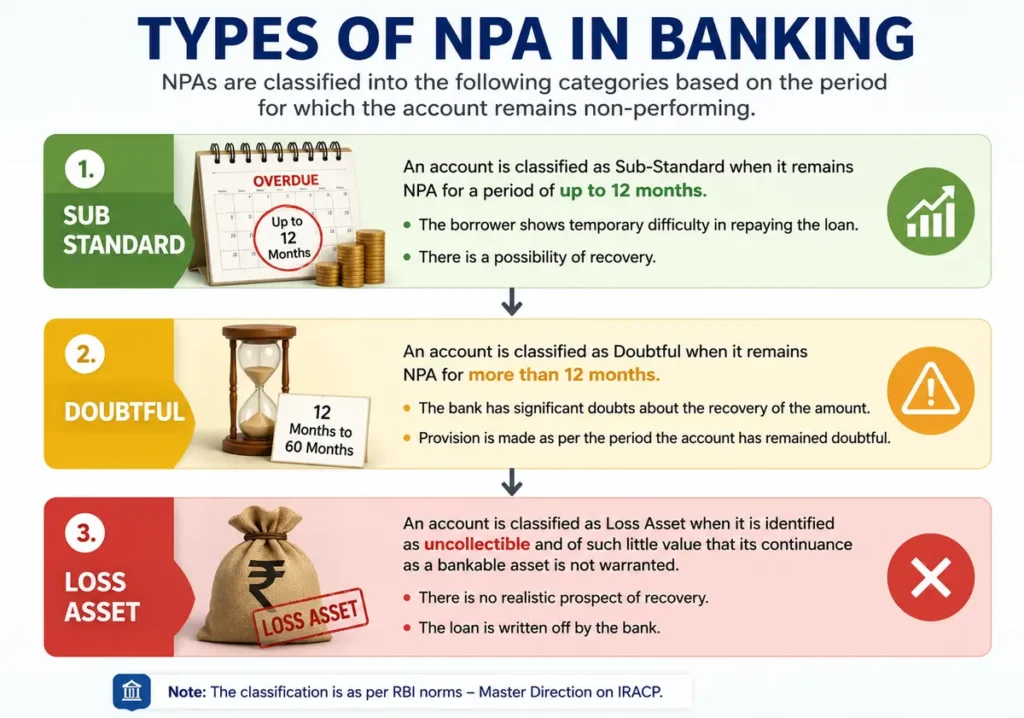
What are the types of NPA in Banking? Now you may be wondering, are all NPAs the same? The answer is no. As per RBI guidelines, there are three main types of NPA. The RBI categorises it based on how long the loan has been outstanding and the likelihood of its recovery.
1. Sub-Standard Asset
When a loan remains in this category for 12 months after becoming NPA, it is called a Sub-Standard Asset. This is the initial stage of NPA. During this period, the bank still has a good chance of recovering the loan. Therefore, the bank tries to contact the borrower and provide various options for repayment.
2. Doubtful Asset
If a loan remains NPA for more than 12 months, it is known as a Doubtful Asset. At this stage, the bank starts to have doubts about whether the entire loan amount will be recovered or not. This also increases the financial risk of the bank.
3. Loss Asset
When the bank or auditor believes that the possibility of recovering the loan is very low or almost gone, it is called a Loss Asset. This is considered the most serious stage of NPA in banking. The possibility of recovering the entire amount from such a loan is very low, and due to this, the bank may have to bear financial losses.
In short, remember: As the duration of NPA in banking increases, the possibility of recovering the loan decreases. That is why banks focus more on recovering the overdue loan in the initial stage itself.
6. Common Causes of NPA
Now comes an important question:n, why does a loan become NPA? It is not always the borrower who deliberately does not pay the instalment. Many times, due to financial or personal circumstances, the loan cannot be repaid on time. Let’s understand some of the common reasons behind NPA.
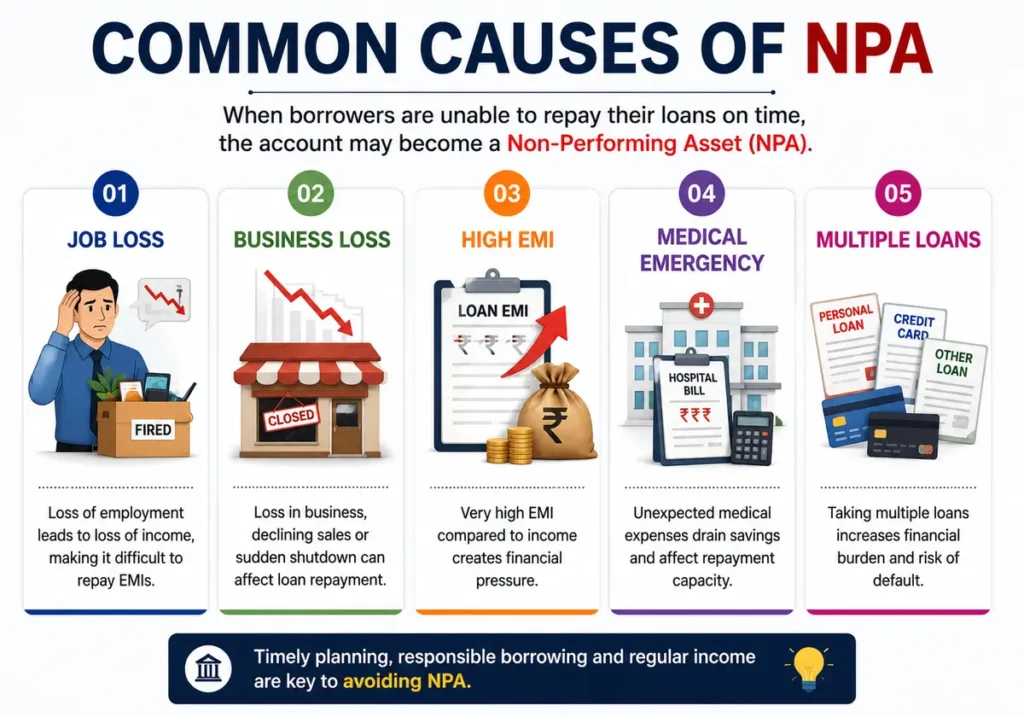
1. Financial difficulties
Suppose there is a sudden loss of job, loss in business or a decrease in monthly income. In such a situation, it may be difficult to pay EMI while meeting household expenses and other needs. This increases the chances of the loan remaining in arrears.
2. Borrowing more than income
Some people take more than one loan without considering their financial capacity. Although everything seems smooth at first, later, when paying multiple EMIs at once, the financial stress increases and the loan may remain in arrears.
3. Increase in interest rate
In some types of loans, if the interest rate increases, the EMI amount also increases. If the income does not increase by the same amount, it can be difficult for many to pay the increased instalment.
4. Business slowdown
For business people, a market slowdown, a drop in sales or a decrease in cash flow can be a big problem. In such a case, it becomes difficult to repay the loan on time.
5. Unexpected situations
Some things in life are beyond our control. Sudden illness, medical expenses, accidents, natural disasters or other emergencies can disrupt financial planning. As a result, EMIs cannot be paid on time, and the risk of the loan becoming NPA increases.
Remember: NPA is not always caused by negligence. Many times, unexpected financial situations also cause it. Therefore, it is best to consider your repayment capacity before taking a loan and contact the bank in time if you face financial difficulties.
7. Why Should Banking Customers and Students Know About NPA?
Now you might be asking, “Why is it important for me to know about NPA?” This question is quite apt. Because NPA is not just a term related to banks, it is also linked to the financial life of every borrower. If you do not pay the EMI or instalment of a loan on time, your loan can become NPA.
This does not only affect that loan, but can also affect your credit history and credit score. If it comes time to take a home loan, car loan or personal loan in the future, it can also affect loan approval.
Now let’s look at it from the perspective of students. If you are preparing for B.Com, BBA, MBA, Banking, Economics or competitive exams, then NPA is a frequently asked and very important topic.
Therefore, it is necessary to understand what NPA is, how it is formed and how it affects banks and customers. In short, whether you are a borrower or a student, knowing about NPA helps you make better financial decisions and understand banking concepts more easily.
Just like other important banking concepts, understanding the MICR code proves useful for every customer.
8. Impact of NPA on Banks and Customers
Now you might be thinking, “If a loan becomes NPA, does it only affect that borrower?” Actually, it is not . The impact of NPA is not limited to the bank alone. It can also affect the borrower, other bank customers and, to some extent,t the entire economy.
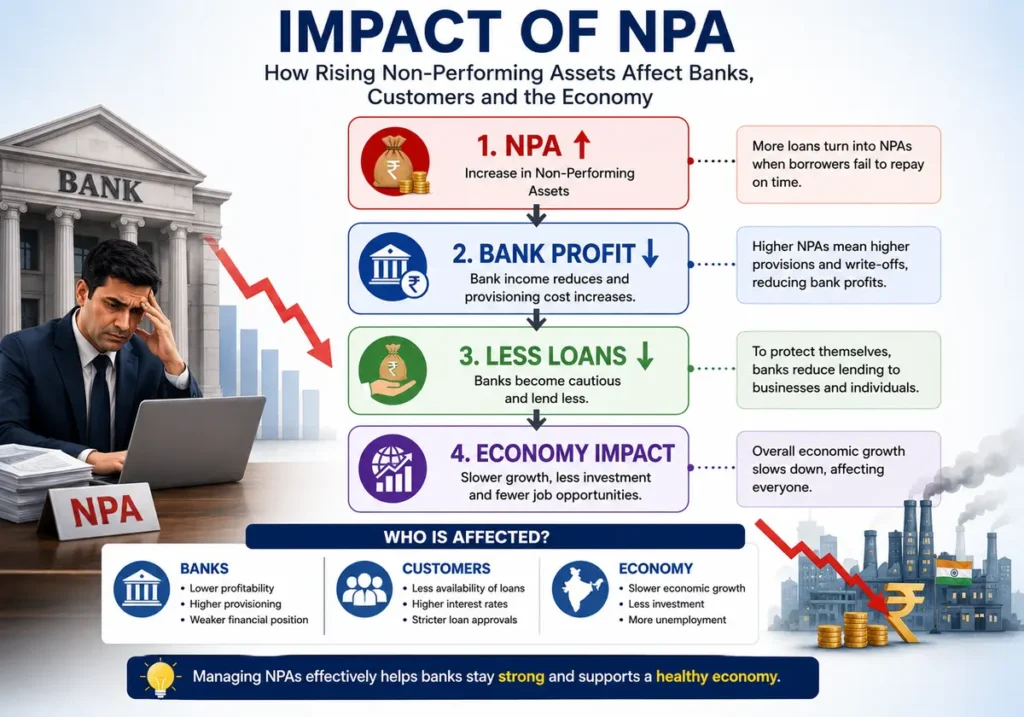
1. Bank profits decrease
The main income of a bank comes from interest on loans. Therefore, when a loan becomes NPA, interest is stopped from that loan. As a result, the bank’s profits are directly affected.
2. The ability to give new loans decreases
When NPA increases, banks have to set aside some funds for potential losses. Due to this, the funds available to lend to new customers may decrease. This can also affect loan disbursement.
3. It may become more difficult to get loans
If a bank has a high NPA ratio, that bank takes a more cautious stance while sanctioning new loans. In such a case, customers may have to provide more documents, face more verification, and sometimes the loan approval may take longer.
4. Interest rates may also be affected
High NPAs increase the financial stress on banks. In some situations, it may also have an indirect impact on the interest rates on new loans. This may put an additional financial burden on customers who take loans in the future.
5. Impact on the entire economy
If banks have fewer funds available to lend, industries, small businesses and new projects may face difficulties in getting the necessary financing. This can have an impact on investment, job creation and overall economic development of the country.
In short, NPA is not just a bank issue but can affect every borrower, bank customer and the entire economy. That is why banks always try to keep NPAs low and ensure that customers repay their loans on time.
Official information regarding the state of India’s banking sector, NPAs, and financial stability is published in the Financial Stability Report.
9. How to Avoid NPA in Banking?
Now the most important question… How to protect yourself from becoming NPA? The good news is that avoiding NPA largely depends on your own financial habits. If you take care of a few simple things, the chances of a loan becoming NPA can be greatly reduced.
1. Always pay EMI on time
Make it a habit to pay your loan EMI or instalment on time. Even if you miss an instalment, pay it as soon as possible and do not let the arrears increase.
2. Take a loan according to your income
Ask yourself one question before taking a loan – “Can I easily pay this EMI every month?” Only if the answer is yes, it would be a good idea to take a loan. Avoid taking a loan that is more than your income.
3. Avoid taking multiple loans at once
If you have multiple obligations like a home loan, car loan, personal loan and credit card arrears at the same time, financial stress can increase. So take a new loan only when necessary.
4. Keep an Emergency Fund ready
Sudden expenses can arise in life. In such a situation, it is always beneficial to keep a separate savings (Emergency Fund) equal to a few months’ expenses ready to avoid stopping the EMI of the loan.
5. Talk to the bank immediately in case of financial difficulties
Many people avoid calling the bank when they face financial difficulties, but this can be the biggest mistake. If you are having difficulty paying EMI, contact the bank immediately instead of missing the instalment. Many times, banks can provide restructuring or other options.
In short, these three habits of paying EMI on time, taking loans only as per your needs, and communicating honestly with the bank in times of difficulty can save you to a large extent from becoming an NPA.
10. Difference between NPA and Bad Loan
Many people think that NPA and Bad Loan are the same. But in reality, it is not. Although these two terms are related to each other, they have different meanings.NPA (Non-Performing Asset) means a loan on which EMI, interest or principal amount has not been repaid for 90 consecutive days or more.
However, at this stage, the bank still has hope of recovering the loan. Therefore, the bank keeps trying to recover the loan by contacting the borrower. On the other hand, Bad Loan means a loan whose chances of recovery are very low or almost gone. In such a situation, the bank takes necessary further action as per the relevant rules.
Understand in simple terms: Every Bad Loan is initially an NPA, but not every NPA becomes a Bad Loan. If the loan is repaid on time or the bank successfully recovers the loan, many NPAs can also be converted back into regular (Performing) loans.
Therefore, NPA is an indication of the overdue state of the loan, while Bad Loan is a more serious condition where the chances of recovery are extremely low.
11. What is Meant by NPA in Banking? : Latest Statistics in India
The NPA ratio in the Indian banking sector has been declining steadily over the past few years. Various reforms undertaken by the government, RBI and banks have led to a significant improvement in the asset quality of banks.
According to the Press Information Bureau (PIB), the Gross NPA Ratio of Scheduled Commercial Banks (SCBs) in India has come down to a historic low of 2.15% as on September 2025.
The Gross NPA Ratio and Net NPA Ratio of Public Sector Banks (PSBs) as on March 31, 2026 were recorded at 1.93% and 0.39%, which is the lowest level ever.
Due to various measures taken by the RBI and the Government of India, such as transparent NPA identification, improved recovery processes and reforms in the banking sector, NPAs have been steadily declining,g and the profitability and lending capacity of banks have become stronger.
Conclusion
NPA (Non-Performing Asset) is a very important concept in the banking sector. If a loan is not repaid on time, it can turn into an NPA, which has an impact on the bank’s profitability, new loan disbursement and the entire economy.
Bank customers should always pay EMIs on time, borrow only according to their financial capacity and communicate with the bank in case of any difficulties.NPA is also a fundamental concept in banking and financial education for students.
In your opinion, what other steps can customers and banks take to reduce NPA in banks in India?
Frequently Asked Questions (FAQs)
1. What is the full form of NPA?
The full form of NPA is Non-Performing Asset.
2. When does a loan become an NPA?
As per RBI rules, when the instalment or interest of a loan remains overdue for more than 90 days, the loan is classified as NPA.
3. What are the three types of NPA?
There are three main types of NPA:
Sub-Standard
AssetDoubtful
Asset Loss Asset
4. Why is NPA harmful for banks?
NPA reduces the interest income of the bank, reduces profits and affects its ability to lend new money.
5. How can borrowers avoid NPA?
Paying EMIs on time, taking loans according to income, keeping an emergency fund ready and contacting the bank immediately in case of financial difficulties are effective ways to avoid NPA.
Disclaimer:The information in this article is provided for educational and general information purposes only. The information regarding NPA (Non-Performing Asset) has been compiled based on the information provided by the Reserve Bank of India (RBI) and other publicly available reliable sources.Bank rules, lending policies and RBI guidelines may change from time to time.
Therefore, before taking any important financial or credit related decision, one should contact the concerned bank or refer to the latest RBI guidelines.The purpose of this article is to increase financial awareness and should not be considered as financial, investment or legal advice. Moneypedia.in shall not be responsible for any profit, loss or other consequences arising from any decision taken based on the information in this article.
References
- Reserve Bank of India (RBI). Master Direction – Prudential Norms on Income Recognition, Asset Classification and Provisioning (IRACP).
- Reserve Bank of India (RBI). Report on Trend and Progress of Banking in India.
- Reserve Bank of India (RBI). Financial Stability Report.
- Ministry of Finance, Government of India. Performance of Public Sector Banks.
- Press Information Bureau (PIB), Government of India. Public Sector Banks – Asset Quality and Gross NPA Updates.
- Mishkin, Frederic S. (2022). The Economics of Money, Banking and Financial Markets (13th Edition). Pearson Education.
- Saunders, Anthony & Cornett, Marcia Millon. (2021). Financial Institutions Management: A Risk Management Approach (10th Edition). McGraw-Hill Education.
- Indian Institute of Banking & Finance (IIBF). Principles and Practices of Banking.

Hello! I’m Abhijeet Bendale, founder of MoneyPedia (Your Trusted Banking Guide). With 8 years of experience in the education field, I aim to simplify banking and personal finance topics for everyday readers through easy-to-understand guides and tutorials.
At MoneyPedia, I share informative content on UPI, digital payments, net banking, ATM and debit cards, mobile banking, and other essential banking topics to help users make smarter financial decisions with confidence.