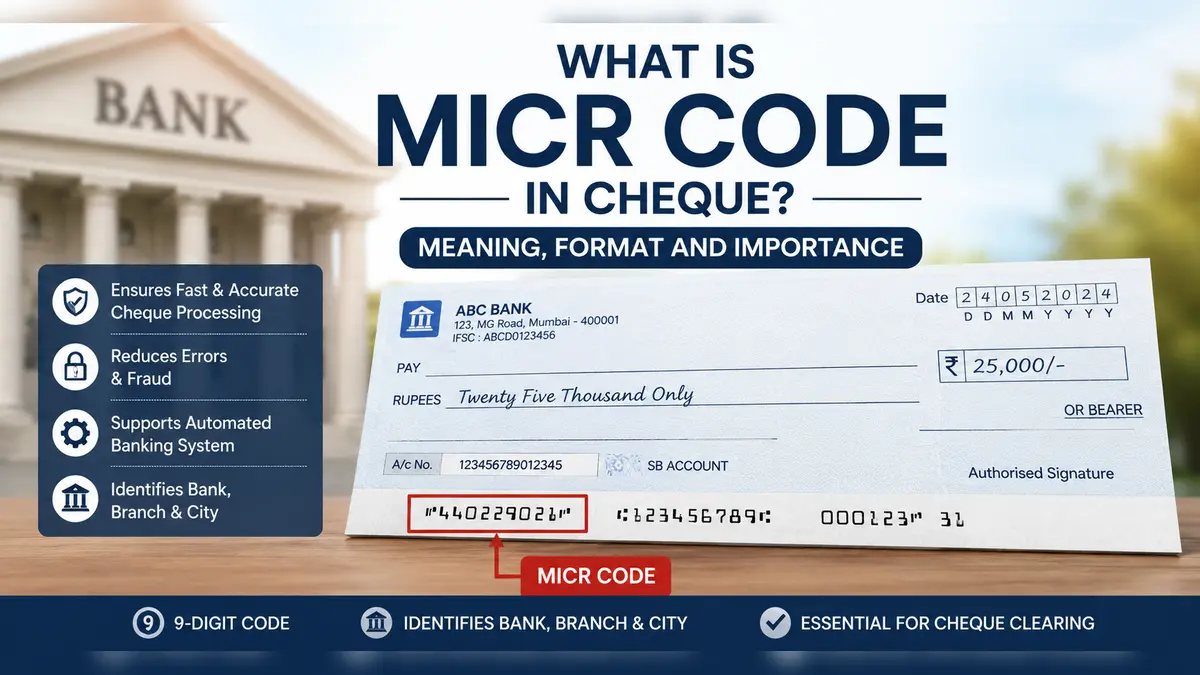
What is the MICR Code in a Cheque? Ramesh received a cheque for ₹50,000 from his customer and subsequently deposited it at the bank. He expected that the funds would be credited to his account within a day or two. However, it took a little longer than expected for the cheque to clear. After enquiring at the bank, he found out that a special system verifies various details on the cheque. At the same time, he saw the MICR code printed at the bottom of the cheque for the first time.
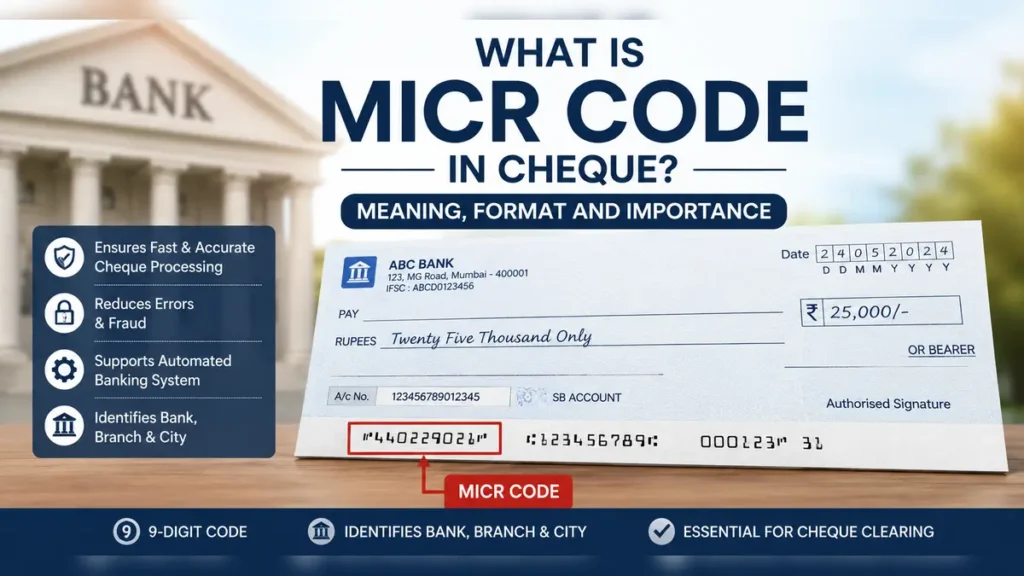
Despite the increasing popularity of digital payment methods such as UPI, IMPS, and net banking, millions of cheque transactions still occur in India. According to the Reserve Bank of India (RBI), banks process cheque transactions worth billions of rupees annually. In this context, the MICR code on a cheque plays a crucial role in the cheque clearing process.
Key Takeaways
- The full form of MICR is Magnetic Ink Character Recognition.
- The MICR Code is a unique 9-digit number printed at the bottom of the cheque.
- The MICR Code includes the City Code, Bank Code and Branch Code.
- MICR technology makes the cheque clearing process quick, accurate and secure.
- The MICR Code is printed with special magnetic ink, so it can be easily read by machines.
- MICR technology reduces human errors and increases banking efficiency.
- MICR Code is used in cheque clearing, ECS transactions, loan processing and investment applications.
- MICR Code can be found in cheque books, passbooks, bank statements and on the bank’s official website.
- MICR Code and IFSC Code are different; MICR is used for cheque processing while IFSC is used for online fund transfers.
- Knowing about MICR codes helps banking customers to make financial transactions more accurately and confidently.
MICR Code Full Form and Definition
The full form of MICR is Magnetic Ink Character Recognition. This technology uses magnetic ink to print numbers that machines can easily read.
This technology uses magnetic ink to print numbers that machines can easily read. These numbers are specifically designed for machine readability and are used in the banking sector to identify, verify, and process cheques more efficiently. India started implementing MICR technology in the 1980s. The aim of this technology was to make the cheque-clearing process more secure, accurate, and faster.
What is the MICR Code in a Cheque?
The MICR Code in a cheque is a 9-digit number printed at the bottom of the cheque. This code identifies the bank, branch and city concerned.
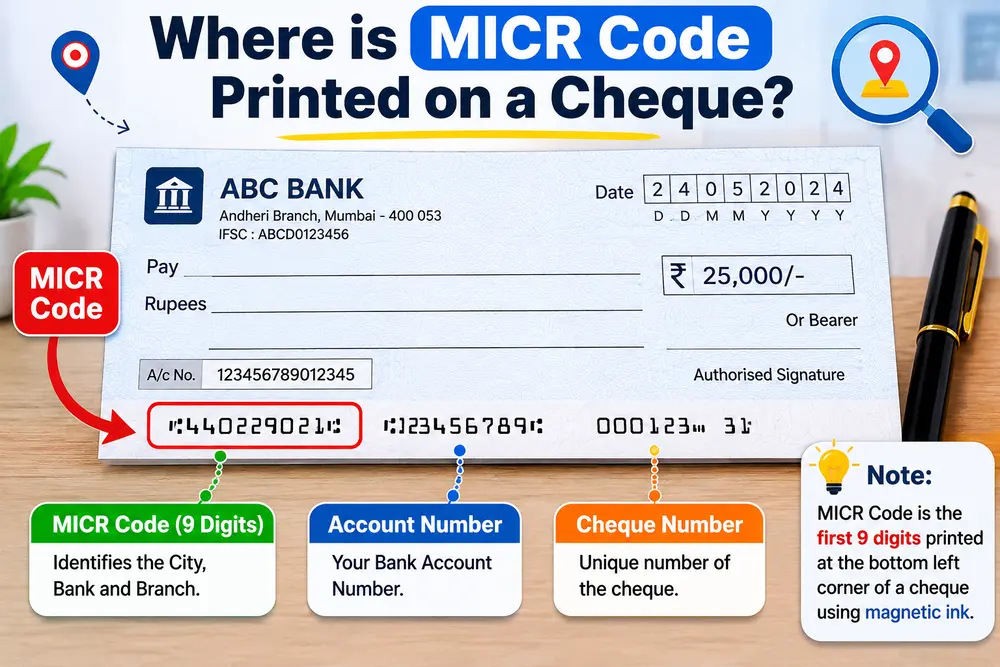
Since this code uses magnetic ink, special machines can easily read it. This reduces human intervention in the cheque clearing process and reduces the chances of errors.
Each bank branch is given a separate MICR Code. Therefore, the banking system can immediately identify which branch issued each cheque.
If you want to know the basics of banking before understanding the MICR Code, then be sure to read this detailed article, What is Banking? Complete Banking Guide.
How Does MICR Code Work?
When a customer deposits a cheque in a bank, a machine called a MICR Reader scans the code at the bottom of the cheque.
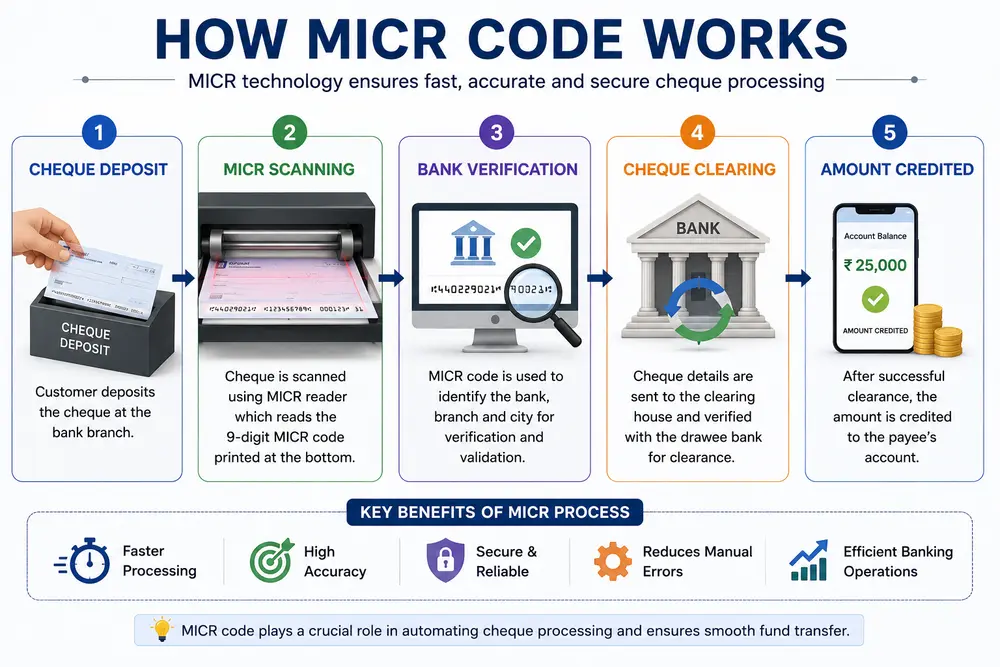
The process is as follows:
- The cheque is scanned by the machine.
- The MICR Code is read.
- The city, bank and branch are identified.
- The account is verified.
- The information is sent to the clearing house.
- The amount is deposited after the transaction is approved.
This entire process ensures that the cheque information is processed quickly and accurately.
Key Features of MICR Technology
MICR technology has many special features. Let us now see what these features are in an expanded form.
1. Magnetic Ink
The MICR code is printed with special magnetic ink. So it can be easily read by the machine. This ink is only used to put the code on the cheque; it is not the ink we use. This ink is used only to print the MICR code on the cheque. Therefore, magnetic ink is the main feature of MICR technology.
2. Standardized Font
Only a specific standard font is used in MICR technology. The MICR code on the cheque is printed in a standard font, such as E-13B or CMC-7. No other font is used in MICR technology.
3. High Accuracy
MICR technology has high accuracy because the code is given on the cheque in a specific font and in magnetic ink, so even if there is a stamp, signature or other marks on the cheque, the MICR Reader can read the code accurately. There is no error in it.
4. Better Security
All bank transactions are completely secure, so this MICR code related to the cheque is known for providing better security. The MICR code on this cheque uses magnetic ink, making it difficult to create a fake cheque.
5. Fast Processing
With the MICR code, there is no need for human resources to process cheques because this code is scanned by a machine, so large-scale cheque transactions can be processed in less time. This advantage is because the machine completely reads the cheque.
Parts of MICR Code in Cheque
The MICR Code has a total of 9 digits.
These are divided into three parts.
Part 1 – City Code
The MICR code on any cheque is a nine-digit code. The first three digits of the MICR code above indicate the city. That is, the first three letters of the code show the city of the bank that issued the check.
Part 2 – Bank Code
The middle three digits immediately after the city code indicate the identity of the concerned bank. That is, these three numbers indicate which bank it is. From these digits, the bank understands to which bank this check belongs. And the transaction is completed by reading it through the machine.
Part 3 – Branch Code
After the first six digits, the last three digits of the MICR provide information about the specific branch. That is, the last three digits indicate which bank this check is drawn by or which bank branch it belongs to, so it becomes straightforward to complete the transaction.
MICR Code Format on a Cheque
Earlier we discussed the parts of the MICR code, i.e., which combination constitutes the MICR code. Now let us see the formats of the MICR code.
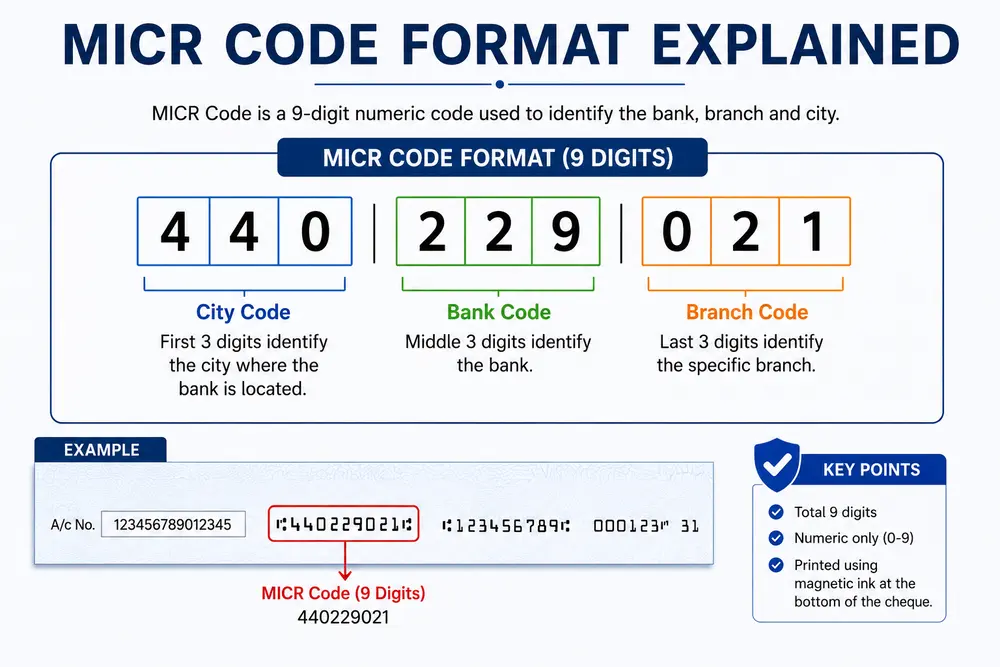
XXX XXX XXX – This is a nine-digit MICR code. In this post, we use the letter X instead of the code to make it easier to understand.
- First 3 digits = City Code
- Middle 3 digits = Bank Code
- Last 3 digits = Branch Code
This allows the bank to immediately understand which city and branch the check belongs to.
MICR Code Example with Explanation
For example, MICR Code:
440229021
In which:
- 440 = Nagpur (City Code)
- 229 = Bank Code
- 021 = Branch Code
This code can be used to accurately identify the relevant branch. Therefore, there are never any problems or errors in cheque-related transactions. Just as the IFSC code is important, the MICR code is also important for completing cheque transactions.
How to Find the MICR Code in a Cheque?
Finding the MICR Code is effortless.
It can be seen in the following places:
- You can also see it at the bottom of the cheque.
- You can see it on the first page of the bank passbook, where all your account and bank details are listed.
- You can also see it in the account statement, at the beginning of the bank and account details.
- When you log in to internet banking, you can see this MICR code in the dashboard.
- You can also find all the information about the bank and the MICR code used for the cheque on the bank’s official website.
- The MICR code of each bank and its branch is also available in the official list of RBI.
If you want to find the IFSC Code of a bank for online transactions, be sure to read this detailed article: How to Find an 11-Digit IFSC Code.
Uses and Benefits of MICR Code
Now in this part, we will see where we can get the use or benefit of this MICR code. There are many uses of this MICR Code.
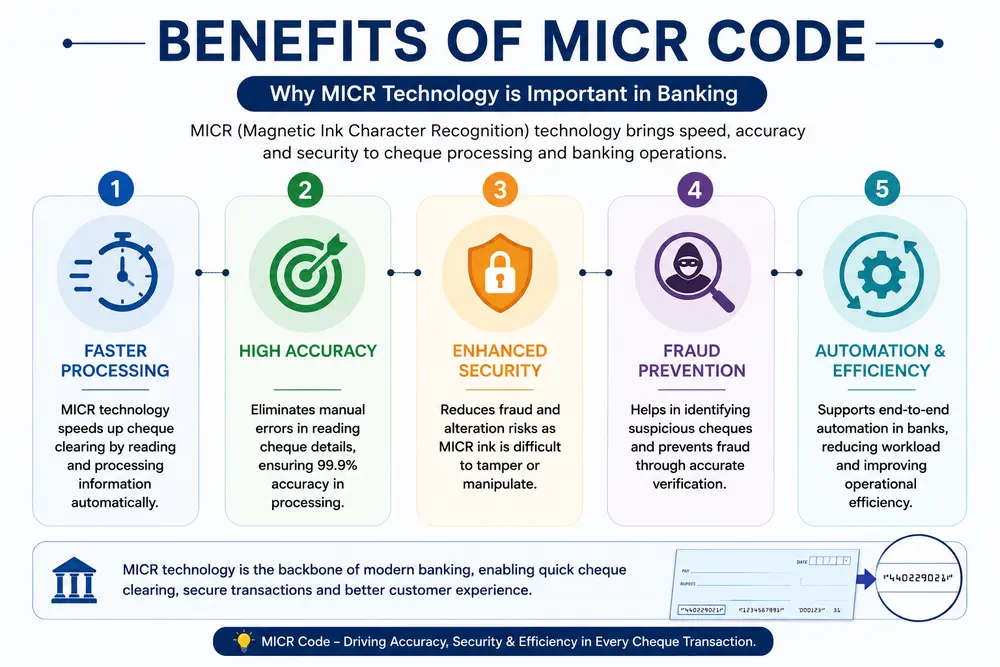
1. Cheque Clearing
Currently, all banks check cheques using machines. This machine scans this MICR code, and the cheque-related transactions are completed immediately. This accelerates the check process.
2. ECS Transactions
MICR Code is used for ECS based transactions. ECS stands for Electronic Clearing Service. In this case, clearing is done electronically. Therefore, ECS transactions are a significant feature of MICR technology.
3. Loan Processing
MICR information may be required in the loan disbursement process. When it comes to loan disbursement, MICR information may be required for loan processing.
4. Mutual Fund and SIP Registration
A Mutual Fund is a pool of money collected from investors and invested in various schemes, such as Hybrid Funds and Debt Investment Funds, with the expectation of generating returns. SIP stands for Systematic Investment Plan. Using this method, we can invest in instalments. Such investments require the MICR Code.
5. Better Security
As discussed earlier, the MICR Code is important for completing all transactions on cheques, and that too completely safely.
MICR plays an important role in preventing fraud in cheque transactions.
How Does MICR Make Cheque Processing Faster?
Earlier, the cheque details were checked manually. These methods increased both time and errors. And due to these factors, it also took more time to complete the transaction regarding the check.
With the advent of MICR Technology:
- The code is read by the machine.
- The branch is identified immediately.
- The need for data entry is reduced.
- Human errors are reduced.
- Clearing time is reduced.
Due to these benefits, all the processes related to the cheque are completed quickly, and the customers receive the money faster.
MICR Code vs IFSC Code: What’s the Difference?
| Feature | MICR Code | IFSC Code |
|---|---|---|
| Number of Characters | 9 Digits | 11 Characters |
| Purpose | Used for Cheque Processing and Clearing | Used for NEFT, RTGS, and IMPS Transactions |
| Format | Numeric Only | Alphanumeric (Letters and Numbers) |
| Main Function | Identifies the Bank Branch for Cheque Clearance | Identifies the Bank Branch for Electronic Fund Transfers |
| Usage | Cheques, ECS, and Banking Verification | Online Money Transfers |
| Recognition | Primarily Used in Cheque Processing Systems | Used Across India’s Digital Banking Network |
Both the MICR Code and the IFSC Code are important banking identifiers, but they serve different purposes. While the MICR Code helps banks process and clear cheques quickly and accurately, the IFSC Code is required for electronic fund transfers such as NEFT, RTGS, and IMPS. Understanding the difference between these two codes can help banking customers complete transactions correctly and avoid unnecessary errors.
Importance of MICR Code for Banking Customers
It is important for banking customers to understand the MICR Code. This is because banking customers need to know this code when they are doing banking-related work. Because the code understands the information on the cheque.
- Understands the information on the cheque
- Can fill financial forms correctly.
- Reduces errors in transactions.
- Recognises the bank branch.
- Increases banking awareness.
Common Mistakes Related to MICR Code
1. Considering MICR and IFSC as one
Most bank customers think that MICR and IFSC codes are the same, but both these codes are different, and both these codes are used for different purposes.
2. Confusing MICR and Account Number
Another mistake is to think that the MICR code and account number are the same. But this is not the case because MICR is not an account number. Account number is different.
3. Understanding Cheque Number as MICR
Some banking customers think that the check number below the check is the MICR code, but these are also different.
4. Using the wrong MICR
Sometimes it is a common mistake made by banking customers that the MICR code is used incorrectly, which can delay the processing of the form.
Frequently Asked Questions (FAQs)
What is the MICR Code in a Cheque ?
A MICR code is a 9-digit identification number on a cheque.
How many digits are there in a MICR Code?
There are 9 digits in total.
Are MICR codes and IFSC the same?
No, both are used for different purposes.
Where can I get the MICR Code?
On cheque books, passbooks and bank websites.
Is MICR required for online transactions?
Generally not. IFSC is used for that.
Conclusion
MICR Code in Cheque is not just a 9-digit number on a cheque but an important part of the modern banking system. It makes the cheque clearing process quick, secure and accurate. Even in the era of digital payments, MICR technology remains important as it ensures reliable transactions for both banks and customers. Now, can you identify and understand the MICR code on your cheque?
References
- Banking Theory, Law and Practice — A comprehensive reference book that covers banking operations, cheque clearing systems, and modern banking technology.
- Indian Financial System — Explains the structure of the Indian banking system, payment mechanisms, and banking regulations.
- Principles and Practices of Banking — Covers banking procedures, payment systems, and cheque processing technologies used in India.

Hello! I’m Abhijeet Bendale, founder of MoneyPedia (Your Trusted Banking Guide). With 8 years of experience in the education field, I aim to simplify banking and personal finance topics for everyday readers through easy-to-understand guides and tutorials.
At MoneyPedia, I share informative content on UPI, digital payments, net banking, ATM and debit cards, mobile banking, and other essential banking topics to help users make smarter financial decisions with confidence.