
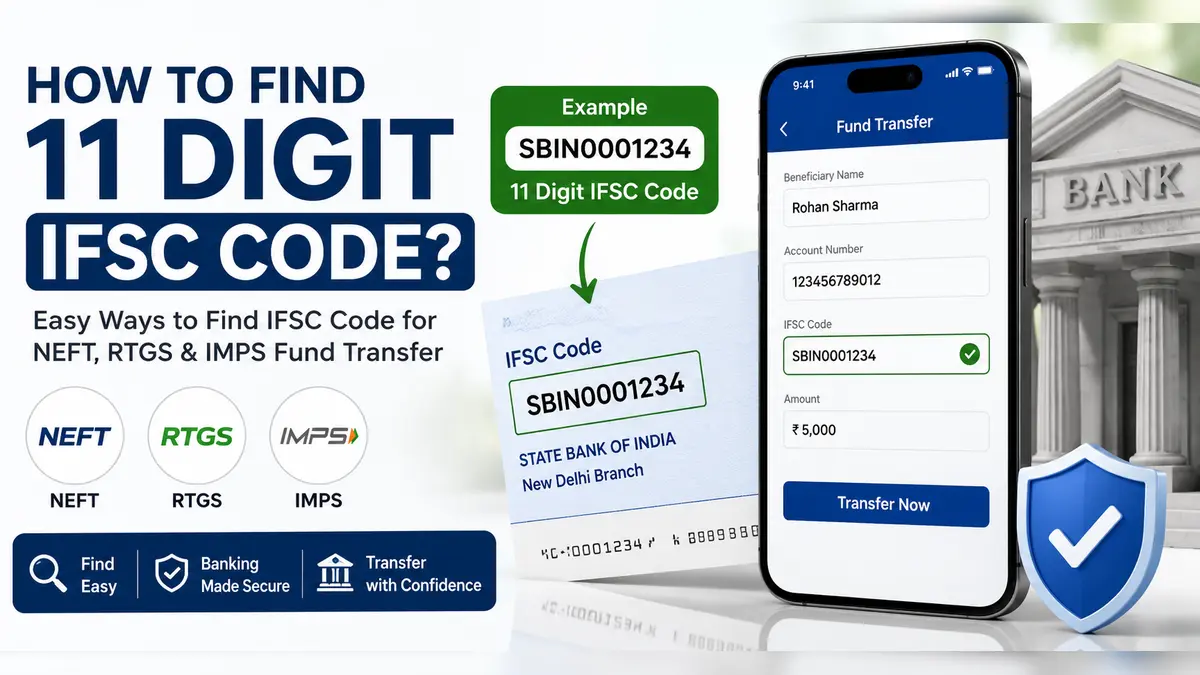
How to Find an 11-Digit IFSC Code: This morning, Pooja was trying to urgently send ₹15,000 to her brother. After entering the account number in the Mobile Banking App, the transaction repeatedly fails. Finally, she realised that the money was not being transferred due to entering the wrong IFSC Code.
This problem happens to thousands of Banking Customers today. Having the correct 11-digit IFSC Code is crucial while using Online Banking, NEFT, RTGS and IMPS.
Digital banking and online fund transfer are growing rapidly in India. According to the Reserve Bank of India (RBI) and NPCI, online transactions are continuously increasing. Therefore, it has become necessary for every Banking Customer to be aware of the IFSC Code.
If you have also wondered, “How to find an 11-digit IFSC code?” then this complete guide is for you.
Key Takeaways
- The IFSC Code is a unique 11-character code given to each bank branch.
- It is very important to have the correct IFSC Code while making online fund transfers.
- You can find the IFSC Code from your passbook, cheque leaf, RBI website, and official bank website.
- The IFSC Code is used for NEFT, RTGS and IMPS transactions.
- The first 4 characters of the IFSC Code identify the bank, while the last 6 characters indicate the branch.
- Entering the wrong IFSC Code can lead to transaction failure or delay.
- The MICR Code and IFSC Code are different; the MICR is used for check processing.
- The IFSC Code also plays an important role in Mobile Banking and SMS Banking.
- For safe banking, always verify the IFSC Code from an official source.
- With the rise of digital banking, it has become necessary for every banking customer to be aware of the IFSC Code.
What is an IFSC Code?
IFSC (Indian Financial System Code) is a unique 11-character alphanumeric code given to each bank branch. This code is issued by the Reserve Bank of India (RBI).
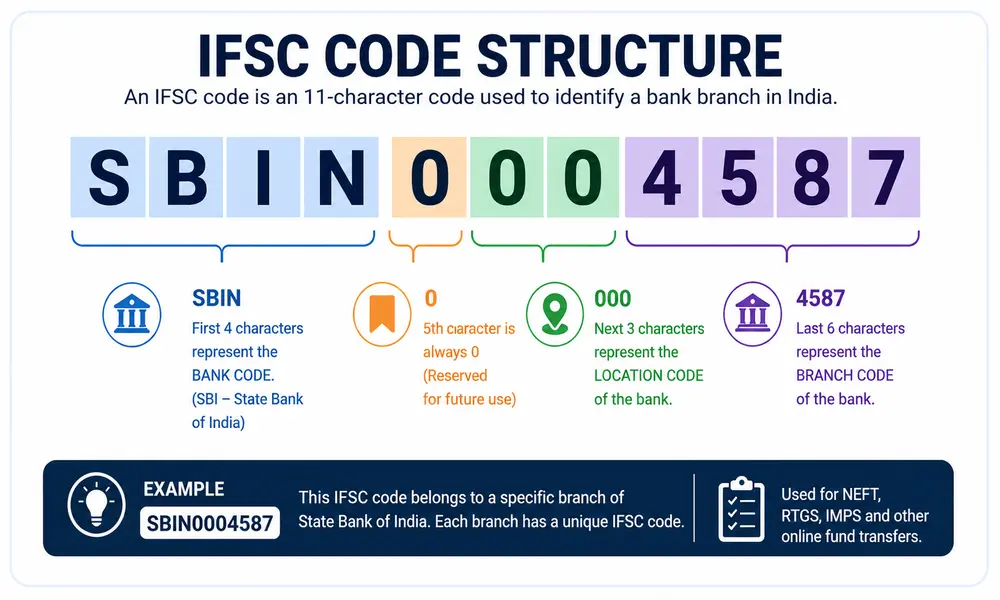
Example: SBIN0004587
In this IFSC Code:
- First 4 characters → indicate Bank Name
- 5th character → is always “0.”
- The last 6 digits represent the specific branch code.
Example: ICIC000027
In this:
- ICIC = ICICI Bank
- 0 = Reserved digit
- 000027 = Specific branch
This IFSC Code is mainly used for NEFT, RTGS, IMPS, and Online Fund Transfer.
How to Find an 11-Digit IFSC Code? 7 Easy Methods
There are many trusted and easy ways to find an IFSC Code. Anyone can find an IFSC Code in a very easy way. If you are also a Banking Customer or you want to know how to find the IFSC code, then you can also use the following methods.
If you want to understand everything from basic to advanced about banking, be sure to read our detailed article What is Banking? 8 Proven Banking Basics (Meaning, Functions & Types, Future Trends).
1. Find the IFSC Code on the Bank Passbook.
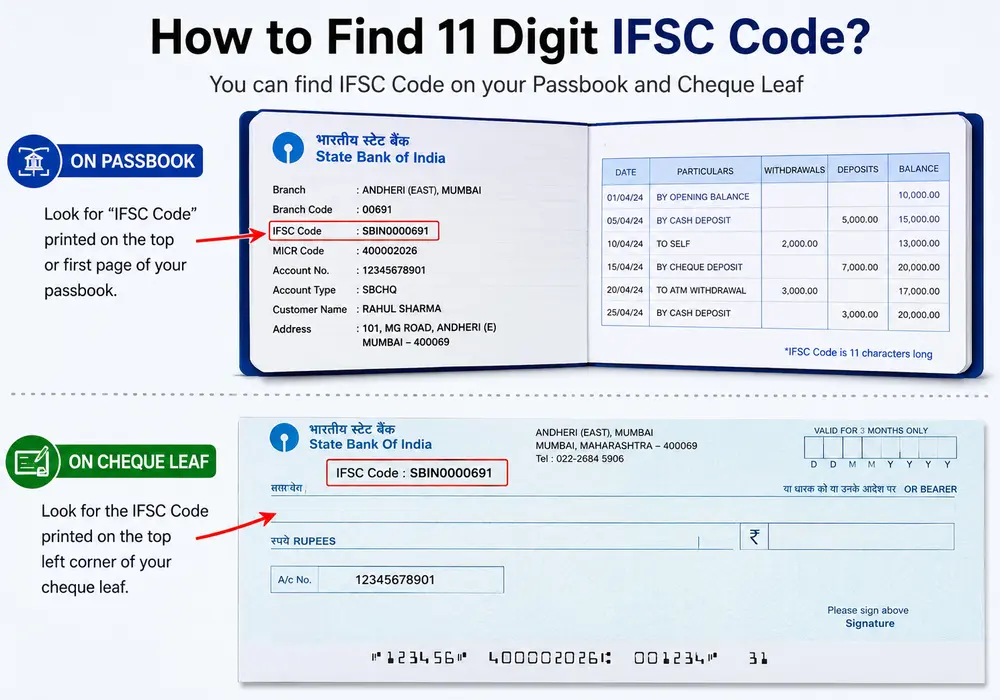
This is the easiest and safest way to use a bank passbook. The bank in which you have an account gives you a passbook. The bank prints its information, the customer’s details, and the IFSC code on the first page of the passbook.
Usually, the first page of the passbook has the following information printed: Account Number, Branch Name, MICR Code, and IFSC Code.
This option is a great option for those who do not know much about online banking, i.e.,
It is considered the most trusted method for users who use offline banking.
2. Check the IFSC Code on the Cheque Leaf.
Just as the bank provides the passbook facility to account holders, it also provides the chequebook to customers based on their requests.
The cheque leaf is another important source for customers who use a chequebook. The IFSC code of your bank is printed at the top of the check, where the account details are.
Generally, the IFSC Code is printed on the top of the check, i.e., on the check at the top or near the account details.
Business account holders and regular banking users quickly find the IFSC Code from a check. This option is also beneficial for individuals who are unable to use phone banking, mobile banking, online banking, or internet banking.
3. Find the IFSC Code from the RBI Website.
The Reserve Bank of India is the apex bank that controls all other banks, which means it holds the IFSC codes for all banks. Therefore, the Reserve Bank of India (RBI) provides IFSC codes for all banks and branches on its official website.
To find the IFSC Code, you can use the following information: Bank Name, State, District, and Branch Name. This source is considered the most reliable.
4. Use the Bank’s Official Website
Just as RBI displays the IFSC Code of all banks in India on its website, similarly, each bank provides its IFSC code as well as the IFSC code of its branches on its official website.
Each bank provides an IFSC finder tool on its website.
Example:
Now let’s see how to find the IFSC code on the official website of the bank.
- 1. First, select the state.
- 2. After selecting the state, select the district.
- 3. Thereafter, select the branch of the bank in whose region you have the IFSC code. and obtain the IFSC code.
5. You can view the IFSC code in the Mobile Banking App.
This option is beneficial for people who are aware of internet banking or mobile banking because here we do not need a chequebook or a passbook.
Nowadays, many banking customers use mobile banking.
After opening the mobile app of any bank, we see our Account Details, Branch Information, and Profile Section. This is where we see the IFSC code of our bank branch.
This method is very convenient for smartphone users.
6. Use Net Banking Dashboard
Just as mobile banking is straightforward to use, net banking is also simple. In mobile banking, you get bank services through a mobile app, but net banking means you get services from this bank by going to the bank’s official website and logging in with your customer ID and password.
After logging in to Internet Banking, you will see the options Account Summary, Branch Details, and Mini Statement for your account. This section provides the IFSC Code.
7. Be careful while using Google Search.
Many people search on Google for the “XYZ Bank Pune IFSC Code”. But there is a possibility of getting fake websites or outdated information.
Therefore, when searching for an IFSC code on Google, you should be mindful of several important factors, such as:
- Use official websites.
- Verify the RBI database.
- Double-check the branch name.
Why is an IFSC Code important?
There are many benefits of using the correct IFSC Code.
- 1. The Correct Bank Branch is identified because the IFSC Code is unique for each branch.
- 2. Fund Transfer Errors are reduced because the chances of wrong branch or failed transaction are reduced.
- 3. NEFT, RTGS and IMPS are secured because the IFSC Code makes online money transfers more secure and accurate.
Benefits of IFSC Code
- 1. Accurate Online Transactions are made because money is transferred to the correct account in NEFT, RTGS and IMPS.
- 2. The Banking Process is Fast because the IFSC Code instantly identifies the bank branch.
- 3. Secure Fund Transfers are made because errors are reduced during online transactions.
- 4. Digital Banking Experience is improved, thus Mobile banking and internet banking become smoother.
How to Transfer Money Using an IFSC Code?
Suppose the IFSC Code is ICIC000027.
In this:
- ICIC means ICICI Bank
- 0 means ‘Reserved digit’.
- 000027 means Mumbai Branch.
When you make an NEFT, RTGS or IMPS transaction, you have to provide the following information:
- Payee Name
- Account Number
- Bank Name
- IFSC Code
After providing this information, the system automatically verifies the IFSC Code and sends the money to the correct branch.
Details of Fund Transfers Using IFSC
Earlier, banks used to charge for some transactions. Now, many banks offer online transfers for free, but some banks’ policies may differ.
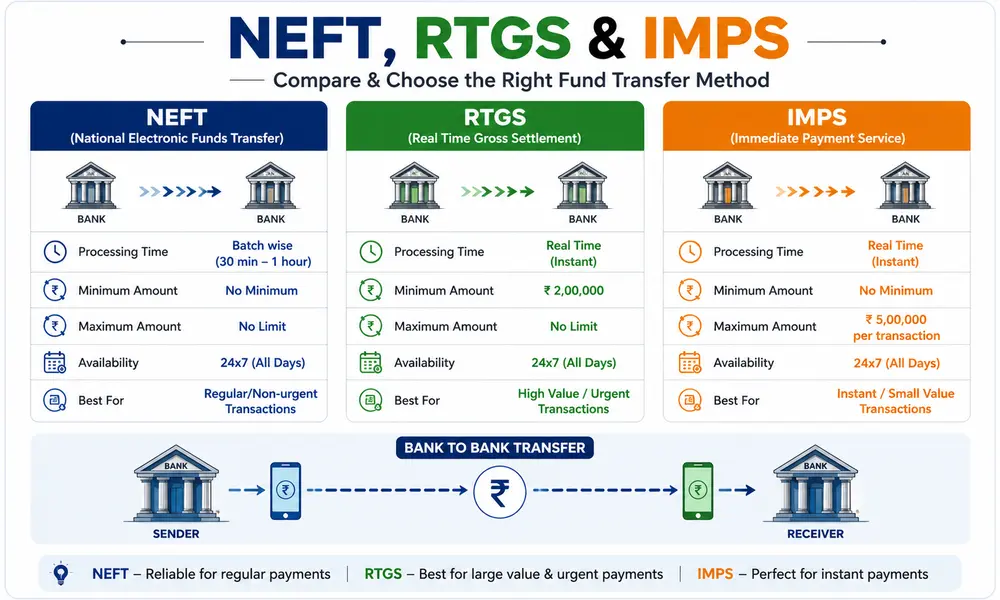
| Amount | NEFT | RTGS | IMPS |
|---|---|---|---|
| Up to ₹10,000 | Low Charges | Not Applicable | Small Charges |
| ₹10,000 – ₹2 Lakh | Moderate | Available | Moderate |
| Above ₹2 Lakh | Available | Mostly Used | Available |
Note:- Charges may vary from bank to bank.
Money Transfer via SMS using IFSC Code
Even today, many banking customers use the SMS Banking service on simple mobile phones. This service is very useful, especially when there is no internet or a smartphone is not available.
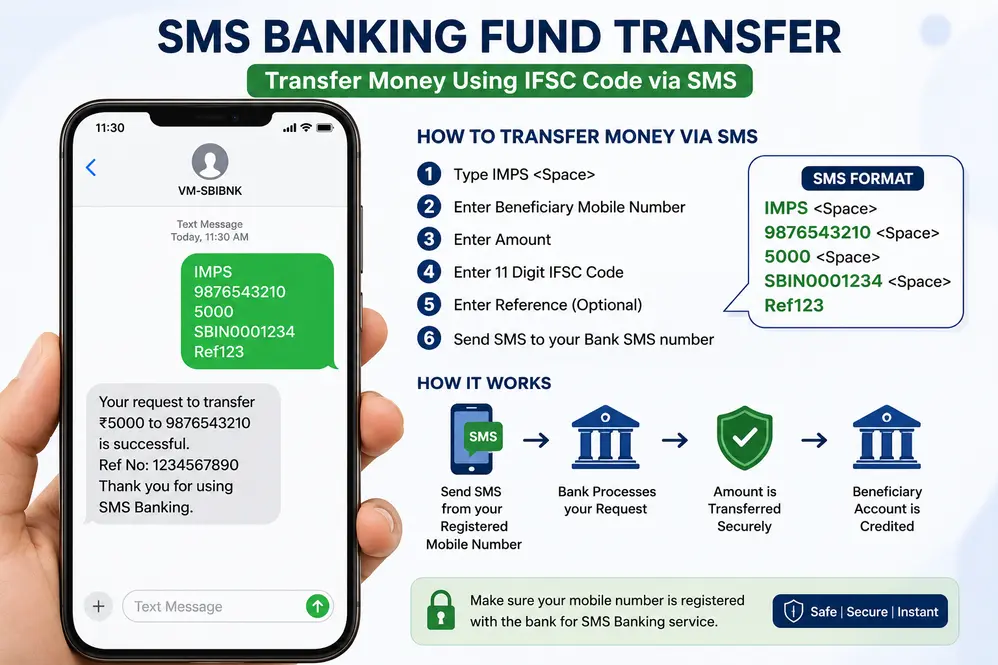
SMS Banking means using important banking services with just one SMS. For example:
- Balance Check
- Mini Statement
- Money Transfer
- Account Alerts
Features like account alerts can be accessed via SMS.
If you want to transfer funds using SMS, then understand the following simple process.
SMS Fund Transfer Process
Step 1: First of all, register your mobile number with the bank account.
Step 2: After completing the registration, get the MMID and mPIN from the bank.
Step 3: After completing the registration, type the SMS in the format given by the bank by entering the Payee Name, Account Number, IFSC Code and Amount.
Step 4: Enter the mPIN received for verification and confirm the transaction.
Step 5: If all the information is correct, the fund transfer will be complete, and you will get a confirmation message.
Difference Between IFSC and MICR Code
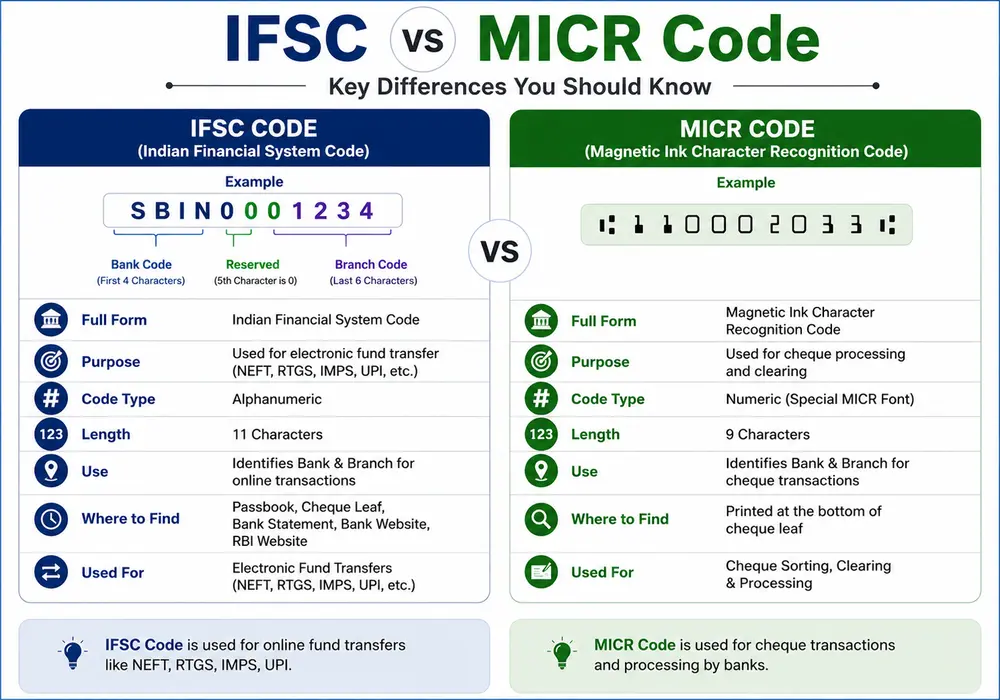
| IFSC Code | MICR Code |
|---|---|
| Used for Online Fund Transfer | Used for Cheque Processing |
| 11-character alphanumeric code | 9-digit numeric code |
| Required for NEFT, RTGS and IMPS transactions | Required for ECS and cheque clearing |
| Assigned by RBI | Works under the RBI-regulated system |
Common Mistakes While Using IFSC Code
Folowing are the common mistakes while using IFSC Code.
- 1. Wrong Branch Selection can be done because branches with similar names can confuse.
- 2. An Old IFSC Code can be used because an IFSC code can change after a bank merger.
- 3. Fake websites can be trusted, but always verify with the official source.
Important Safety Tips for Banking Customers
Followings are the safety tips for Banking customers regarding IFSC Code.
- 1. Always use the official website for Banking Services
- 2. Find the IFSC Code only from the RBI website and avoid Fake IFSC finder websites if possible.
- 3. Always verify the branch name before transferring money.
- 4. Check the Saved Beneficiary because sometimes old IFSC Codes may have changed.
- 5. Do not blindly trust the Screenshot Information for such transactions.
- 6. Always use the updated source for Banking Services.
Frequently Asked Questions (FAQs) : How to Find an 11-Digit IFSC Code
How many digits does the IFSC Code have?
IFSC Code is 11 characters.
Are IFSC Code and Branch Code the same?
No. The branch code is in the last 6 characters of the IFSC.
How to find the IFSC Code if you don’t have a passbook?
You can use the RBI website or the official bank website.
Is an IFSC Code required for UPI?
It is usually not required for normal UPI payments, but it may be required in some account linking processes.
Where is MICR Code used?
It is used in Cheque processing and the ECS system.
Can the IFSC Code change?
Yes. It can change after a bank merger or branch migration.
Conclusion
In this article, you must have definitely gotten the answer to the question, “How to Find an 11-Digit IFSC Code?”
In today’s digital banking era, understanding the IFSC Code has become crucial for every banking customer. Using the correct IFSC Code is essential to make NEFT, RTGS, IMPS and online fund transfers safe and error-free. You can easily find the 11-digit IFSC Code using a passbook, check leaf, RBI website, official bank website, or mobile banking app.
With proper IFSC Code awareness, your banking transactions become more secure, fast, and reliable—so which method are you going to use to verify your IFSC Code?
References
- Reserve Bank of India (RBI)
- National Payments Corporation of India (NPCI)
- Data.gov.in – Digital Payment Statistics
- State Bank of India Official Website
- Indian Banking and Financial System – Dr S. Gurusamy
- Banking Theory, Law, and Practice – Gordon & Natarajan
- Principles and Practices of Banking – Indian Institute of Banking and Finance (IIBF)
- Fundamentals of Banking and Insurance – Dr P.K. Gupta

Hello! I’m Abhijeet Bendale, founder of MoneyPedia (Your Trusted Banking Guide). With 8 years of experience in the education field, I aim to simplify banking and personal finance topics for everyday readers through easy-to-understand guides and tutorials.
At MoneyPedia, I share informative content on UPI, digital payments, net banking, ATM and debit cards, mobile banking, and other essential banking topics to help users make smarter financial decisions with confidence.